INTRODUCTION
In international literature, recruitment and selection for military institutions are treated as educational and professional decision-making processes, in which the intention to pursue a career is influenced by personal, social, and institutional factors, and is then filtered by eligibility criteria, including medical and physical standards. A frequently used framework for explaining intention is the Theory of Planned Behavior, which links attitudes, social norms, and perceived control to choice intention and subsequent behavior [1]. In the same area, Social Cognitive Career Theory explains educational choices through self-efficacy, outcome expectations, and environmental supports or barriers [2]. In applications, when deciding to enlist, it was shown that young people's intention is also influenced by their parents' recommendations and beliefs, which indicates the role of the close social environment in choosing a military career [3].
In Europe, recruitment is conditioned by the socio-demographic context, i.e. the size of age cohorts, educational mobility and labour market pressure, and these conditions can alter the recruitment base and candidate profile across countries and periods [4].
From this perspective, the analysis of the profile of those who become eligible for and enter military institutions becomes relevant for human resource planning, for recruitment communication and for support measures in the transition to the military environment.
An international research direction tracks the socio-educational profile of cadets and the differences between institutions in the same national system. For example, a study of the three service academies in Portugal uses questionnaires administered to all cadets and describes differences in social and geographical origin, as well as gender distribution, suggesting that recruitment patterns may differ between institutions [5].
Another major theme is gender mainstreaming and the effects on attitudes and cohesion during the initial training period. Recent data from basic training, collected across several military services, describe differences between services and between sexes in attitudes related to gender and cohesion, with direct implications for how training is organized and for integration policies [6].
In parallel, the selection literature shows that physical performance can be a significant predictor of success in demanding selections, and physical tests function as a threshold that changes the composition of the eligible batch [7]. In the present study, this perspective justifies the use of a sample of participants who passed the selection, without physical performance being treated as the main variable of the analysis. Therefore, to realistically describe the population that actually reaches military institutions, it is useful that socio-educational analyses be made on already eligible samples, not only on general populations or on the declared intention to follow the career.
According to the Bologna principles, pre-university and university military education in the defense, public order and national security system is part of state education, free of charge, integrated into the national system and the European Education Area, and the programs carried out in the structures of the Ministry of Defense comply with educational policies and national quality standards, aiming at the training of skills specific to weapons, services and military specialties [8].
To meet current security and international cooperation requirements, the training of military personnel must follow European strategic directions and be compatible with the training and development systems used by NATO armies [9].
It is not sufficiently known what the socio-educational profile of those who actually become students in different military institutions looks like, in an integrated picture, when they come from different educational paths, military high schools versus civilian high schools, scientific versus humanistic profile, rural versus urban environment, female versus male gender, and when a simple indicator of declared training before selection is included, yes or no. In many studies, these elements are presented fragmentarily, either only descriptively on a single institution, or without comparisons between institutions, or without including declared training before selection as a context variable.
The present study makes a contribution by describing and comparing the socio-educational profile of a sample of 120 participants from three military institutions, the “Nicolae Bălcescu” Land Forces Academy, the “Ferdinand I” Military Technical Academy, and the “Decebal I” Military School of Warrant Officers and Non-Commissioned Officers for Communications, Information Technology and Cyber Defense. The novelty consists in analyzing together the type of high school graduated from, military or civilian, the educational profile, scientific, humanistic or other profile, the living environment, rural or urban, gender, as well as the training declared before selection, yes or no, with comparisons between institutions and between groups.
The international relevance results from the fact that many European systems recruit candidates from different educational backgrounds and aim to understand the real recruitment base, including the distribution by gender and the provenance, and a comparable descriptive profile, completed with information on the declared training before selection, can be used as a benchmark for comparisons between institutions and contexts.
The scientific contribution of the study consists in moving the analysis from recruitment intention to the socio-educational structure of a batch, already filtered by physical eligibility, which more accurately captures the real basis for entry into military institutions. Furthermore, combining inter-institutional comparisons with a logistic model for declared training before selection provides an analytical framework transferable to other military systems or organizations with threshold selection. The aim of the study is to describe the socio-educational profile and the provenance of the participants and to analyze the differences between institutions and between groups, in relation to the type of high school, educational profile, the provenance, gender and training declared before selection, yes or no.
In the present study, the Theory of Planned Behavior and Social Cognitive Career Theory are used as interpretive frameworks rather than as fully tested causal models. Within this perspective, the type of high school attended and the educational profile may reflect prior educational routes that shape attitudes toward a military career and perceived compatibility with institutional requirements. Area of origin and gender are treated as background and contextual characteristics that may influence access to information, perceived supports and barriers, and social expectations regarding military education. Self-reported pre-selection training is interpreted as a proximal indicator of behavioral preparation, which may reflect perceived control, self-efficacy, and commitment to the chosen educational pathway. Therefore, the differences identified between institutions are not interpreted as direct tests of these theories, but as observable patterns consistent with different combinations of educational background, contextual opportunity, and preparation before selection.
1. The objectives are:
1. To describe the distribution of participants by type of high school graduated, educational profile, the provenance and gender, overall and by institutions;
2. To compare these distributions between institutions;
3. To describe the proportion of those who declare training before selection and to compare it between institutions and between groups defined by type of high school, educational profile, the provenance and gender.
Working Hypotheses
4. The distributions by type of high school and educational profile differ between the institutions analyzed;
5. The distributions by the provenance differ between the institutions analyzed;
6. Distributions by gender may differ between the institutions analyzed;
7. The proportion of declared training before selection, yes or no, differs between the institutions analyzed;
8. The declared training before selection, yes or no, is associated with the type of high school, educational profile, the provenance and gender.
RESEARCH METHODOLOGY
The study has an observational, cross-sectional, descriptive, and analytical design, based on a questionnaire administered to students and pupils in military institutions. In parallel, bibliographic analysis was used to substantiate the theoretical framework and interpret the results.
The sample included N=120 participants from three military institutions: the “Nicolae Bălcescu” Land Forces Academy, N=22, the “Ferdinand I” Military Technical Academy, N=69, the “Decebal I” Military School of Warrant Officers and Non-Commissioned Officers for Communications, Information Technology and Cyber Defense, N=29. The sample is non-probabilistic, of convenience, the participants being recruited on a volunteer and accessibility basis, without random selection.
Inclusion criteria
Enrollment as a participant in one of the three institutions analyzed, students at AFT and ATM and students at SCTIAC, promoting the assessment of motor skills, voluntary and anonymous filling out of the questionnaire.
Exclusion criteria
Records with missing values for variables included in the analysis were removed before analysis, the final analyzed set was N=120.
Data were collected through an online questionnaire comprising 23 predominantly nominal items. The questionnaire was developed by the author for descriptive purposes, based on the objectives of the study and the literature reviewed in the introduction, and was intended to capture the socio-educational background of participants and selected aspects related to preparation before admission. The instrument was distributed online to participants from the three military institutions included in the study. It was not designed as a psychometric scale, but as a structured descriptive tool. No formal pilot testing was conducted before administration. For the present article, 6 variables were selected from the full questionnaire because they correspond directly to the analytical focus of the study, namely inter-institutional differences in socio-educational profile and declared preparation before selection: institution, type of high school attended, educational profile, area of origin, gender, and self-reported pre-selection training. The remaining items referred to complementary descriptive aspects that fall outside the scope of the present paper and may be analyzed separately in future work.
Self-reported pre-selection training was operationalized as a dichotomous variable YES/NO, based on participants’ answer to whether they had undertaken any form of preparation before admission and selection. This preparation may have included formal or informal individual training, but the questionnaire did not collect detailed information on duration, frequency, intensity, supervision, or specific training content. Therefore, this variable should be interpreted as a simplified self-reported indicator of prior preparation rather than as a standardized measure of training exposure.
For contingency tables, verification of the application conditions of the χ² test was performed based on expected frequencies, and the interpretation was supported by effect size and Pearson residual analysis. The questionnaire was administered online, via Google Forms, using the same link and instructions for all participants. Filling out the questionnaires was voluntary and anonymous. The responses were exported in a tabular format for analysis.
The questionnaire was descriptive in purpose, with predominantly nominal items, and this study did not seek psychometric validation or estimation of internal consistency.
The analysis included descriptive statistics, frequencies and percentages, overall and by institution, as well as comparisons between institutions and between groups defined by type of high school, educational profile, the provenance and gender. Contingency tables and the Chi-square test were used to examine associations between categorical variables, and the effect size was assessed by Cramer's V. Statistical analyses were performed in Jamovi, using frequencies, percentages, the χ² test, Cramer's V, and binary logistic regression.
Participation was voluntary, and completing the questionnaire required informed consent. No personally identifiable data were collected, and the responses were used exclusively for scientific purposes, in aggregate form.
Although the assessment of motor skills is mentioned in the title, in this study it functions as a selection filter for the investigated population, as the participants passed this threshold and were enrolled in the institutions analyzed. The analysis focuses on the socio-educational profile and the declared training before selection, not the performance on the motor tests as the main variable.
RESULTS
Complete data for n = 120 participants were analyzed. Associations between categorical variables were examined using the chi-square test, χ², and effect sizes were reported using Cramer’s V. Pearson residuals were used to identify the cells that contributed most to the associations, with absolute values greater than 2 indicating relevant deviations from independence.
Table 1 Relationship between type of high school attended and military institution.
| Crt. No. | Military institution | Military High-School (FO) | Civil High-School (FO) | Military High-School (FE) | Civil High-School (FE) |
|---|---|---|---|---|---|
| 1. | AFT | 0 (0%) | 22 (100 %) | 8,98 | 13,02 |
| 2. | ATM | 49 (71,0%) | 20 (29,0%) | 28,18 | 40,83 |
| 3. | SCTIAC | 0 (0 %) | 29 (100%) | 11,84 | 17,16 |
The type of high school attended differed markedly across institutions. Military high school graduates were concentrated in the Military Technical Academy, while civilian high school graduates predominated in the Land Forces Academy and SCTIAC. The association was statistically significant and strong, χ²(2, N=120)=61.21, p<0.001, Cramer’s V=0.71. Pearson residuals confirmed that the largest deviations from independence were observed in SCTIAC, where civilian high school graduates were overrepresented and military high school graduates were underrepresented, and in the Military Technical Academy, where the opposite pattern was found.
Table 2 Relationship between educational profile and institution attended
| Crt. No. | Military Institution | Scientific Profile (FO) | Non Scientific Profile (FO) | Scientific Profile (FE) | Non Scientific Profile (FE) |
|---|---|---|---|---|---|
| 1. | AFT | 19 (86,4%) | 3 (13,6%) | 17,97 | 4,03 |
| 2. | ATM | 64 (92,8%) | 5 (7,2%) | 56,35 | 12,65 |
| 3. | SCTIAC | 15 (51,7%) | 14 (48,3%) | 23,68 | 5,32 |
Educational profile also differed significantly across institutions. The scientific profile predominated in all three institutions, but non-scientific profiles were disproportionately concentrated in SCTIAC and less represented in the Military Technical Academy. The association was statistically significant and strong, χ²(2, N=120)=23.35, p<0.001, Cramer’s V=0.44. Pearson residuals indicated that the clearest deviation from independence was the overrepresentation of non-scientific profiles in SCTIAC, accompanied by their underrepresentation in the Military Technical Academy.
Table 3 Relationship between area of origin and military institution
| Crt. No. | Military Institution | Urban (FO) | Rural (FO) | Urban (FE) | Rural (FE) |
|---|---|---|---|---|---|
| 1. | AFT | 7 (31,8%) | 15 (68,2%) | 12,28 | 9,72 |
| 2. | ATM | 46 (66,7%) | 23 (33,3%) | 38,52 | 30,48 |
| 3. | SCTIAC | 14 (48,3%) | 15 (51,7%) | 16,19 | 12,81 |
Area of origin also varied significantly across institutions. Rural origin was more common in the Land Forces Academy, whereas urban origin predominated in the Military Technical Academy. The association was statistically significant and of moderate strength, χ²(2, N=120)=9.10, p=0.011, Cramer’s V=0.28. Overall, the pattern suggests that the three institutions draw participants from somewhat different rural-urban backgrounds, even if the contrast is less pronounced than for type of high school or educational profile.
Table 4 Relationship between gender and institution attended
| Crt. No. | Military Institution | Female (FO) | Male (FO) | Female (FE) | Male (FE) |
|---|---|---|---|---|---|
| 1. | AFT | 11 (50,0%) | 11 (50,0%) | 7,70 | 14,30 |
| 2. | ATM | 20 (29,0%) | 49 (71,0%) | 24,15 | 44,85 |
| 3. | SCTIAC | 11 (37,9%) | 18 (62,1%) | 10,15 | 18,85 |
Gender distribution did not differ significantly across institutions. Although the observed proportions varied slightly, the association was not statistically significant and the effect size was small, χ²(2, N=120)=3.38, p=0.184, Cramer’s V=0.17. Therefore, the available data do not support the existence of a stable institutional pattern in gender composition within this sample.
Table 5 Relationship between declared pre-selection training and institution attended
| Crt. No. | Military Institution | YES (FO) | NO (FO) | YES (FE) | NO (FE) |
|---|---|---|---|---|---|
| 1. | AFT | 18 (81,8%) | 4 (18,2%) | 16,32 | 5,68 |
| 2. | ATM | 54 (78,3%) | 15 (21,7%) | 51,18 | 17,83 |
| 3. | SCTIAC | 17 (58,6%) | 12 (41,4%) | 21,51 | 7,49 |
Declared pre-selection training did not differ significantly across institutions. Although the proportion of participants reporting prior preparation was lower in SCTIAC than in the Land Forces Academy and the Military Technical Academy, the association did not reach the conventional significance threshold, χ²(2, N=120)=4.93, p=0.085, Cramer’s V=0.20. Therefore, Hypothesis 3 was not supported, although the observed distribution may indicate a pattern worth examining in larger samples.
Table 6 Relationship between declared pre-selection training and type of high school attended
| Crt. No. | Type of high school graduated | YES (FO) | NO (FO) | YES (FE) | NO (FE) |
|---|---|---|---|---|---|
| 1. | Military High-School | 40 (81,6%) | 9 (18,4%) | 36,34 | 12,66 |
| 2. | Civil High-School | 49 (69,0%) | 22 (31,0%) | 52,66 | 18,34 |
Declared pre-selection training was somewhat more frequently reported by military high school graduates than by civilian high school graduates, but the association was not statistically significant, χ²(1, N=120)=2.41, p=0.121, Cramer’s V=0.14. Therefore, the available data do not support a reliable difference by type of high school in this sample, although the observed distribution may justify further investigation in larger groups.
Table 7 Relationship between declared pre-selection training and educational profile
| Crt. No. | Educational Profile | YES (FO) | NO (FO) | YES (FE) | NO (FE) |
|---|---|---|---|---|---|
| 1. | Scientific Profile | 71 (72,4%) | 27 (27,6%) | 72,68 | 25,32 |
| 2. | Non-scientific Profile | 18 (81,8%) | 4 (18,2%) | 16,32 | 5,68 |
Declared pre-selection training did not differ significantly by educational profile. Although participants with a non-scientific profile reported prior preparation slightly more often than those with a scientific profile, the association was not statistically significant, χ²(1, N=120)=0.82, p=0.364, Cramer’s V=0.08. Therefore, the available data do not support a meaningful difference by educational profile in this sample.
Table 8 Relationship between declared pre-selection training and area of origin
| Crt. No. | Living Environment | YES (FO) | NO (FO) | YES (FE) | NO (FE) |
|---|---|---|---|---|---|
| 1. | Rural | 38 (71,7%) | 15 (28,3%) | 39,31 | 13,69 |
| 2. | Urban | 51 (76,1%) | 16 (23,9%) | 49,69 | 17,31 |
Declared pre-selection training did not differ significantly by area of origin. The proportions were similar in rural and urban participants, and the association was not statistically significant, χ²(1, N=120)=0.43, p=0.510, Cramer’s V=0.06. Therefore, the available data do not support a meaningful difference by area of origin in this sample.
Table 9 Relationship between declared pre-selection training and gender
| Crt. No. | Gender | YES (FO) | NO (FO) | YES (FE) | NO (FE) |
|---|---|---|---|---|---|
| 1. | Female | 38 (90,5%) | 4 (9,5%) | 31,15 | 10,85 |
| 2. | Male | 51 (65,4%) | 27 (34,6%) | 57,85 | 20,15 |
Declared pre-selection training differed significantly by gender. Female participants reported prior preparation more frequently than male participants, and the association was statistically significant, χ²(1, N=120)=8.97, p=0.003, Cramer’s V=0.27. This result indicates a moderate association, suggesting that gender was one of the few variables clearly related to self-reported preparation before selection in the present sample.
Table 10 Multivariate binary logistic regression for declared pre-selection training
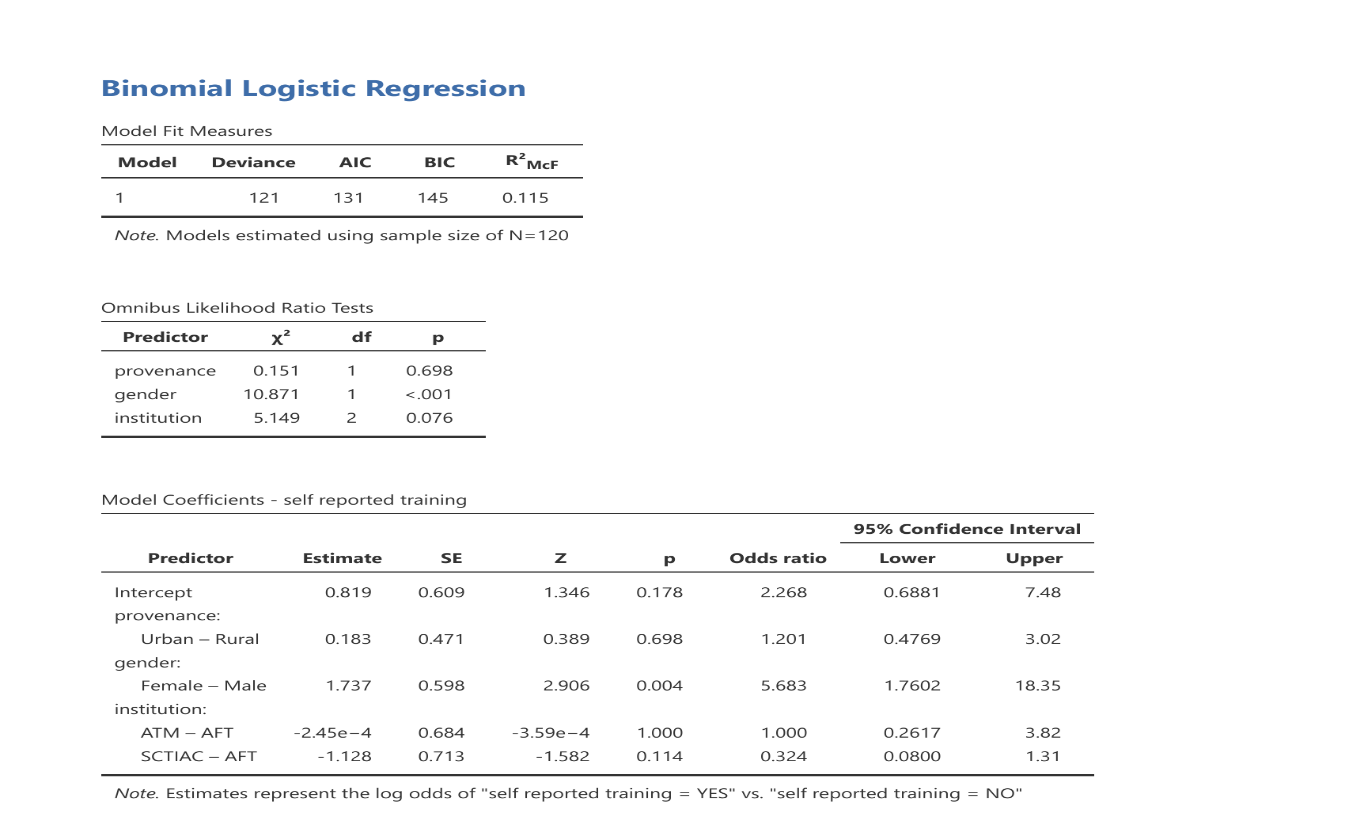
Note: The dependent variable is preparation = YES vs NO, and OR>1 indicates a higher probability of declaring YES, compared to the reference category.
In the multivariate logistic regression model, gender remained the only significant predictor of declared pre-selection training after adjustment for area of origin and institution. Female participants had higher odds of reporting prior preparation, whereas area of origin and institutional affiliation did not reach statistical significance. Although the model identified a significant gender effect, its explanatory power was limited, suggesting that other factors not included in the present analysis may also influence self-reported preparation before selection.
DISCUSSION
The findings point to differentiated socio-educational patterns across the analyzed military institutions. These differences may be consistent with processes of self-selection and institutional continuity, but the present data do not allow these mechanisms to be tested directly. From the perspective of the Theory of Planned Behavior, the observed distributions may reflect differences in attitudes toward a military career, perceived social expectations, and perceived compatibility with institutional requirements. From the perspective of Social Cognitive Career Theory, they may also reflect differences in self-efficacy, expected outcomes, and contextual supports or barriers [1], [2]. Therefore, the results are interpreted as patterns compatible with these theoretical frameworks, rather than as direct evidence of the underlying mechanisms.
International literature shows that the intention and orientation towards a military career can be shaped by the immediate social environment, including parental influence, which supports the interpretation that the socio-educational profile is not only descriptive, but reflects a decision-making and filtering process [3]. In addition, the socio-demographic context can modify the recruitment base and the profile of candidates depending on the country and period, so that differences between institutions can also be understood as an effect of structural conditions and educational mobility [4].
Comparatively, differences between institutions within the same national system have also been reported in military academies in Portugal, where cadet profiles vary between institutions according to the provenance and socio-demographic distributions, suggesting distinct recruitment patterns [5]. Therefore, the pattern observed in this study is plausible and in line with international evidence, and the explanations relate to differentiated access to information, perceived compatibility with the institution's requirements, and expectations regarding academic and professional success.
Similar to the results in Portugal, differences emerge between institutions within the same national system. In this case, the difference by type of high school is stronger, because there is the military high school sector, which can amplify the separation between educational routes and chosen institutions.
The results support the need for recruitment and orientation messages tailored to educational profiles and rural-urban contexts, as well as standardized pre-selection training recommendations. Gender-related differences in reported preparation indicate the usefulness of support interventions that reduce variations between groups and increase the consistency of pre-admission preparation.
Although the study is conducted in a single national system, the analytical structure is transferable to contexts where selection includes physical and educational thresholds. Comparing socio-educational profiles across institutions, after filtering for eligibility, can support the calibration of recruitment messages, pre-selection training programs, and transition measures for underrepresented groups. Regarding declared preparation before selection, the association with gender and the maintenance of the effect in multivariate analysis suggest a stable difference that is not explained by institution or area of origin. International results on recruit profiles and gender mainstreaming in initial training highlight that gender differences may have implications for the way training is organised and for the support provided during the transition period [6]. The selection literature also shows that physical performance can function as a threshold that changes the composition of the eligible batch, which supports the analysis on an already eligible sample, without making physical performance the main variable of this article [7]. At the same time, the relatively low explanatory power of the logistic regression model suggests that additional factors not included in the present analysis may also influence self-reported pre-selection training, such as prior sports participation, access to training resources, family support, or individual motivation.
CONCLUSIONS
The socio-educational profile differs between the institutions analyzed, with large effects for the type of high school and educational profile, and a moderate effect for the rural-urban environment, while the gender distribution does not differ significantly. Declared preparation before selection does not differ significantly between institutions, but is associated with gender and remains significant in the multivariate logistic model. The conceptual contribution consists of describing the socio-educational profile of an already eligible population, suggesting patterns that may reflect self-selection mechanisms, and the applicative contribution consists of implications for orientation, recruitment communication and pre-selection training recommendations adapted to the identified profiles.
The study used a convenience sample and a cross-sectional design, which limits the generalizability of the results and does not allow for causal interpretations. Pre-selection training was self-reported and did not include measurement of training duration or intensity, and some category combinations had low frequencies. In addition, physical performance functioned as an eligibility filter, not analyzed as an outcome variable.
Future research may include larger samples and comparative designs across institutions or national systems, to test the stability of the observed socio-educational patterns. Also, the integration of objective measures of physical performance and quantifiable indicators of training would allow for more robust predictive models of adaptation and success in initial training.