1. INTRODUCTION
In the late 20th century, agriculture became a cornerstone of the global economy, particularly in developing regions like Africa, Asia, and Latin America. This sector is vital for nearly 50% of the world's population, providing essential livelihoods and food security . In developing countries agriculture sector is one of critical economic sector employing around 2.5 billion people. In Africa agriculture plays a pivotal role in economic sector through employment, trade, food security, and overall GDP . It serves not only as a primary income source but also as a means of sustaining rural communities. The sector fosters economic generation and resilience, enabling families to thrive despite challenges . As such, investing in agricultural development is crucial for enhancing food systems, improving living standards, and driving economic growth across the continent.
Ethiopia has 16.3 million hectares of arable land, which accounts for 14.5% of its total land area; however, only 34.2% of this arable land is currently utilized for agriculture. Ethiopia possesses an impressive irrigation potential of 5.3 million hectares; however, only a small fraction of this approximately 10% is currently being utilized . This underutilization highlights a significant gap in agricultural productivity that could be addressed through improved water management practices. Furthermore, while around 50% of rural farming households are familiar with tractors and related mechanization technologies, only 5.7% have actually employed these tools in their farming practices . This disparity indicates a critical barrier to the modernization of agriculture in the country.
Several scholars have identified low adoption rates of agricultural technology as a key factor impeding agricultural production in Ethiopia. Research conducted by , , , , and , underscores limited use of modern farming equipment and irrigation techniques. As a result agricultural production in Ethiopia is characterized by subsistence orientation, low productivity, low level of technology and inputs, lack of infrastructures and market institutions, and extremely vulnerable to rainfall variability. Hence, to enhance productivity, it is essential to promote education and access to technology among farmers, thereby enabling them to take full advantage of agricultural potential.
The term "mechanization" is commonly used to describe the application of various production inputs, including powered machinery utilized in farming, irrigation, and livestock production . These machines are designed to alleviate the efforts of humans and livestock, replacing their roles in production, protection, harvesting, processing, preservation, and transportation (Clarke, 2014). Agricultural mechanization technology significantly enhances production and productivity by improving labor efficiency and land productivity. It also increases the timeliness, efficiency, and consistency of field operations . This is particularly crucial for land preparation in Ethiopia, where sequential tillage practices are employed during the mono-season .
Enhancing agricultural transformation through the modernization of farming and livestock husbandry practices can significantly increase employment opportunities and accelerate poverty reduction. A critical measure taken to improve this sector is the promotion of mechanized technologies, such as tractors. The use of tractors is a pivotal factor influencing overall production and productivity . In countries like Ethiopia, where agriculture relies heavily on rainfall, the adoption of tractor technology can greatly improve rural households' preparedness for climate variability. By facilitating timely planting and efficient land management, tractors can help farmers adapt to changing weather patterns, ultimately leading to more resilient agricultural practices. This transformation not only boosts food security but also empowers communities by creating jobs and fostering economic growth, thereby contributing to a sustainable reduction in poverty levels .
Numerous studies across various countries highlight the impact of tractors on agriculture. In East Africa, agricultural mechanization enhances productivity by improving soil fertility . In India, agricultural machinery boosts productivity and household income . In Ghana, mechanization increases productivity, replaces labor, and creates employment opportunities . Overall, agricultural mechanization, particularly the use of tractors, improves production and productivity by enhancing labor and land efficiency , expanding cultivated land access beyond what animal traction can reach , improving soil fertility, and enhancing the climate resilience of farming communities . Agricultural mechanization, especially through tractors, significantly enhances productivity, soil fertility, and climate resilience while creating employment opportunities across various regions. Hence, this study aims to evaluate the effect of tractor adoption on land and labor productivity in Woliso District, Oromia, Ethiopia.
2. STATEMENT OF THE PROBLEM
Though agriculture is the foundation for food security, rural and urban job opportunities, and it is a base to ensure national economic growth; the world is currently facing unprecedented challenges in agricultural development . Among these challenges, climate change stands out. Changes in weather patterns can lead to diseases, loss of biodiversity, and crop failures resulting in soil erosion and water scarcity, which are major contributors. Another significant issue is the shortage of agricultural inputs which closely linked to soil degradation that led to reduction of crop yields . Consequently, as food production decreases in relation to population growth, there is a possibility in the prevalence of food insecurity and diminishing of job opportunities contributing to economic stagnant . During off season, urban to rural migration increases which leads to urban poverty and instability. This migration further exacerbates the challenges faced in agricultural development causing labor shortages to agricultural production.
The existing scenario of agricultural development of Ethiopia shows that, agriculture is facing several challenges. One of the critical factor is lack transformation in the sector. Transforming in a sense is mean by transforming backward agricultural practice to modern, from oxen-based tillage system to tractor, from animal back product transportation to motorized, and overall enhancement from production to consumption. Because of lack of transformation, fragmented farming, extensive animal rearing, agricultural production is substances to hands to mouth. Now a days, over 90% of farming community ploughing farms by oxen, and there is sufficient evidence that our agriculture is agriculture is lagging behind . Vulnerability to disasters and rainfall shortages, limited capital to create access to agriculture technology including tractors are some contributing factors for the abovementioned constraints. Hence, the failure to modernize agricultural and rural life has resulted in reduction to agricultural production and making rural living less attractive.
Ethiopia's agricultural development faces significant challenges, primarily due to a lack of transformation. The sector remains stuck in outdated practices, relying on oxen for plowing and traditional methods for transportation. Over 90% of farmers still use oxen to plough land, highlighting the urgent need for modernization from adopting tractors up-to improving production and product preservation practices. This stagnation leaves agriculture vulnerable to disasters and rainfall shortages, while limited access to capital hampers the provision of essential technologies . Consequently, agricultural production has declined, making rural life less attractive, and reducing farmers' quality of life. Besides citizens commitment to change, policy targeted to modernize and transform agriculture and rural community takes significant places to the aforementioned issues.
Based on the notion that 'agriculture is lacking transformation,' it is essential to study the benefits of tractor adoption and related agricultural mechanization, along with its contributing factors and associated constraints. To identify the impact of tractors on agricultural production, we have assessed numerous related studies to uncover gaps, enabling policymakers, users, and future researchers to have a look at on this critical finding. For instance, studied on the prospect of agricultural mechanization, and their finding revealed that land topography, limited operators’ number, soil difficulty, price of spare part and fuel, limitation in road connectivity are among the constraint of the technology in Ethiopia.
Research done by on agricultural technology emphasizing improved seed fertilizer as technology, and , and on agricultural technology in general indicated technology adoption improves production. In Africa particularly in east Africa agricultural mechanization improves production productivity . Another research done by , , and , emphasized on agricultural mechanization prospects, challenges and policy reform suggestion. , done on tractor preferences compared to cost of labor and oxen, done on socioeconomic factor to adopt tractor machinery, , on factors determine farmers decision to hire tractor. In general, as far available research done in Ethiopia on agricultural mechanization, there are gaps in identifying labor and land productivity impact of tractor in mixed approach research design. Hence this particular study aims to examine impacts of tractor on labor and land productivity using a mix of qualitative and quantitative data.
3. METHODOLOGY
3.1. Background of the study area
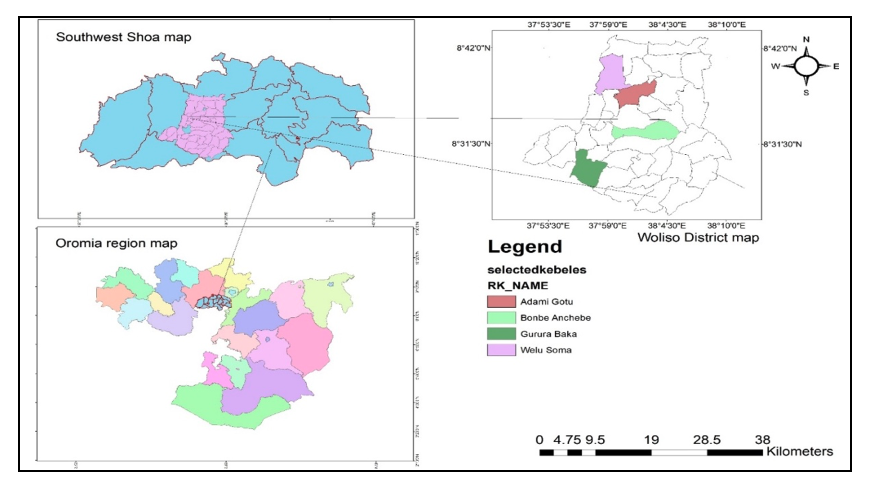
Woliso district is located to the southern of Addis Ababa far from the Capital 90-126 km long on the main road Addis to Jimma. There are about 35 rural kebeles and 3 urban kebeles out of which 29% is highland, 6% is lowland, 65% is semi high land with their agro-ecological setting. The district is found from 1600-3600 meter above sea level, gets 10’c-35’c temperature annually, and 1100 ml-1400ml rain fall annually, where the district has 23,750 HH’s. The district has a total of 23,750 households. The majority of community in Woliso Woreda is engaged in agriculture. The major crop produced in the Woreda is Teff, Maize, Wheat, Burley, and Sorghum. However, other crops like vegetable, legumes, and spices are being produced.
3.2. Sampling sample size determination
The study focused on the Southwest Shoa Zone in Oromia, specifically the Waliso district, to investigate agricultural mechanization and food security. The total number of 337 sample households were identified while the total household number of 4(four) kebeles are 2709. The sample households were selected using systematic random sampling from the chosen kebeles, with respect to proportional to the population size of respective kebeles. Hence the household numbers 75, 99, 85, 78, are identified for response from Adami Gotu, Gurura Baka, Tombe Anchebi, and Walu Soma kebeles respectively.
For qualitative data collection, the study employed a purposive sampling strategy to select key informants and focus group discussion participants. Key informants were chosen based on their knowledge and experience related to the research topics, ensuring that the gathered insights from individuals who could provide valuable perspectives. Focus group discussion participants were also purposively selected from each of the four villages and across various stakeholder groups within the district. This included community leaders, local government workers, and sample households with differing viewpoints to foster diverse discussions.
3.3. Data type and collection techniques
To achieve the research objectives, both quantitative and qualitative data gathered from secondary and primary sources were utilized. The quantitative data encompassed several key metrics, including the number of laborers per household, total land holdings, the adoption status of households regarding agricultural technologies, and overall farm production levels. In addition, qualitative data focused on perceptions of the impact of tractors on land and labor productivity, as well as the prospects and trends related to tractor adoption, and challenges associated with tractor mechanization in the study area was gathered.
By integrating these two methodological approaches, the study aimed to develop a comprehensive understanding of the issues under investigation. This dual approach allowed to enrich the analysis with a diverse array of perspectives and experiences from study area community. The combination of quantitative metrics provided a solid foundation for statistical analysis, while qualitative insights offered deeper contextual understanding and nuanced interpretations of the data. Ultimately, this holistic methodology enabled the study to capture the complexities of agricultural practices and mechanization within the district, facilitating more informed recommendations for future development initiatives.
3.4. Data analysis techniques
Labor and land productivity can be calculated as the labor used as a share of total HHSs annual production and total production obtained per hectare of land respectively. As shown in equation (1 and 2), which displays the labor and land productivity calculation in this study .
Pl=APll-------------------(1)
Where Pl is total productivity of labor (in quintals per annual labor)
APl is annual production of labor in quintals, and
l is unit of labor used
Pl=APfh------------------(2)
Where Pl is total productivity of land (quintals per hectares)
APf is total production of farmers, and
h is unit of hectare land used
The above equations is to compute labor and land productivity in favor of tractor adoption. Labor and land productivity has a linear relationship, and they computed by regressing land and labor productivity with adoption by MANOVA. MANOVA is generalization of ANOVA allowing multiple dependent variables. According to pioneering work found in Anderson (2003) and Wilks (1932) four multivariate statistics are commonly computed in MANOVA; since the regression contain two-way vector dimension matrix and there were two dependent and one independent variable to be regressed. Wilks’s lambda, Pillai’s trace, Lawley–Hotelling trace, and Roy’s largest root are among estimation test. All four tests are admissible, unbiased, and invariant. Asymptotically, Wilks’s lambda, Pillai’s trace, and the Lawley–Hotelling trace are the same, but their behavior under various violations of the null hypothesis and with small samples is different. Roy’s largest root is different from the other three, even asymptotically. None of the four multivariate criteria appears to be most powerful against all alternative hypotheses (Anderson, 2003).
MANOVA is obtained by specifying the dependent variables followed by an equal sign, followed by the categorical variable defining the groups. Therefore, necessary test held to see if labor and land productivity mean of adopters and non-Adopters are different. The null hypothesis is that the mean vectors are the same for adopter and non-adopter. Besides, multivariate regression analysis was used as a coefficient displayer after MANOVA to view the coefficients, standard errors, t statistics, p-values, and confidence intervals of the multivariate regression model underlying the previous MANOVA. Accordingly, the mathematical and Econometric specification of this part is as follows:
Yi=Xiβ+ε………………..(3)
Leads to multivariate hypothesis of the form
CβA'=0; Where β a matrix of parameters, C is specifying constraints on the design matrix X for particular hypothesis, and A provides a transformation of Y. A is often the identity matrix.
An estimate is provided by:
B=X'Y'-X'Y……………..(4)
The error sum of squares and cross products (SSCP) matrix is:
E=AY'Y-B'X'XBA'……………………(5)
And the SSCP matrix for the hypothesis is
H=ACB' {CX'X-C'}- 1 CBA'……………………(6)
The inclusion of weights, if specified, enters the formula in a manner similar to that shows in methods and formulas of (R) regress.
A=∏t=1n 11+λt=|E||H=E|……………………………(7)
Hence, the likelihood ratio test’ and the statistic is distributed as the Wilks’s A distribution if E has the Wishart distribution. H has the Wishart distribution under the null hypothesis, and E and H are independent. The null hypothesis is rejected for small values of A.
For the perception analysis, the study employed straightforward statistical techniques to present the responses of households and key informants regarding their attitudes toward the effects of tractor use on land and labor. This approach allowed the analysis to quantify perceptions and identify patterns in the data, providing a clearer understanding of community sentiments. To analyze the qualitative feedback from key informants and focus group discussion participants, the again utilized simple content analysis.
This method involved systematically categorizing and interpreting the responses to uncover recurring themes and insights related to the impact of tractors on agricultural practices in general and land and labor productivity in particular. Ultimately, this analysis technique enabled the analysis to draw meaningful conclusions about the implications of mechanization for land and labor dynamics in the region.
4. RESULT AND DISCUSSION
In this section, we thoroughly explore descriptive statistics and its analytics, econometric techniques, and qualitative data analysis to enhance understanding, about the comparison of adopters and non-adopters farming household with their land and labor productivity.
The summary of the research data reveals that key insights involving a total of 337 households in the selected four village. Out of total HH, 83 of them are adopters. Notably, the adopters employed a total of 230 working laborers in the last production season, in contrast to the non-adopters, who utilize 991 laborers. In terms of production, the adopters yield an average 22.67 quintals per HH while their total productions are 1882 quintals, whereas non-adopters obtained yield on average 11.45 quintals per HH and total production 2908. Furthermore, the total farm size for adopters’ measures 117.35 hectares which is 1.41 on average per HH, compared to 330.52 hectares for non-adopters which is 1.30 hectares per HH on average. These figures underscore a significant finding that adopters are achieving higher production levels despite utilizing fewer labor resources and less farmland than their non-adopting counterparts. This efficiency suggests that the practices or tractor technology adopted by these households may be more effective, allowing them to maximize output with limited inputs, assuming other production factors the same for both categories.
4.1. MANOVA of labor and land productivity
The labor of household heads (HHS) is a crucial variable influencing the adoption of tractors, as previously highlighted. Additionally, the size of the land owned by these households is a significant factor in this decision-making process. While labor availability and land size are important considerations, this study also emphasizes the productivity of both labor and land as a result of tractor adoption in the study area. To comprehensively assess the impact of tractor adoption on labor and land productivity, various other factors must be taken into account. These include soil fertility, the use of fertilizers, the implementation of improved seed varieties, as well as the timing and seasonality of plowing. For labor productivity, metrics such as effective time of production and man-day equivalents are also evaluated.
By controlling for these variables among both adopters and non-adopters, the study aims to isolate the specific contributions of tractor usage to enhancements in labor and land productivity. The data analysis employs a statistical method known as MANOVA (Multivariate Analysis of Variance) to discern these effects. The results obtained from this analysis will be presented as following:
Table 1:Test statistics (estimation & hypothesis test)
| Multivariate Testsa | |||||||||||||||
|---|---|---|---|---|---|---|---|---|---|---|---|---|---|---|---|
| Effect | Value | F | Hypothesis df | Error df | Sig. | Partial Eta Squared | |||||||||
| Tractor adoption status | Pillai's Trace | .691 | 372.643b | 2.000 | 334.000 | .000 | .691 | ||||||||
| Tractor adoption status | Wilks' Lambda | .309 | 372.643b | 2.000 | 334.000 | .000 | .691 | ||||||||
| Tractor adoption status | Hotelling's Trace | 2.231 | 372.643b | 2.000 | 334.000 | .000 | .691 | ||||||||
| Tractor adoption status | Roy's Largest Root | 2.231 | 372.643b | 2.000 | 334.000 | .000 | .691 | ||||||||
| a. Design: Intercept + tractor adoption status | |||||||||||||||
| b. Exact statistic | |||||||||||||||
| Tests of Between-Subjects Effects | |||||||||||||||
| Source | Dependent Variable | Type III Sum of Squares | df | Mean Square | F | Sig. | Partial Eta Squared | ||||||||
| Corrected Model | Labor productivity | 4121.302a | 1 | 4121.302 | 446.496 | .000 | .571 | ||||||||
| Corrected Model | Land productivity | 3407.634b | 1 | 3407.634 | 426.508 | .000 | .560 | ||||||||
| Intercept | Labor productivity | 13214.477 | 1 | 13214.477 | 1431.638 | .000 | .810 | ||||||||
| Intercept | Land productivity | 41737.478 | 1 | 41737.478 | 5223.971 | .000 | .940 | ||||||||
| Tractor adoption status | Labor productivity | 4121.302 | 1 | 4121.302 | 446.496 | .000 | .571 | ||||||||
| Tractor adoption status | Land productivity | 3407.634 | 1 | 3407.634 | 426.508 | .000 | .560 | ||||||||
| R Squared = .571 (Adjusted R Squared = .570) Table 2: Estimated coefficient and summary of adoption in terms labor and land productivity | |||||||||||||||
| b. R Squared = .560 (Adjusted R Squared = .559) | |||||||||||||||
| Parameter Estimates | ||||||||||||
|---|---|---|---|---|---|---|---|---|---|---|---|---|
| Dependent Variable | Parameter | B | Std. Error | t | Sig. | 95% Confidence Interval | Partial Eta Squared | |||||
| Dependent Variable | Parameter | B | Std. Error | t | Sig. | Lower Bound | Upper Bound | Partial Eta Squared | ||||
| Labor productivity | [tractor adopter] | 8.117 | .384 | 21.130 | .000 | 7.361 | 8.872 | .571 | ||||
| Labor productivity | [tractor non-adopter] | 0a | . | . | . | . | . | . | ||||
| Land productivity | [tractor adopter] | 7.380 | .357 | 20.652 | .000 | 6.678 | 8.083 | .560 | ||||
| Land productivity | [tractor non-adopter] | 0a | . | . | . | . | . | . | ||||
| a. This parameter is set to zero because it is redundant. | ||||||||||||
| Comparison | ||||||||||||
| Tractor adoption status | Mean | Std. Deviation | N | |||||||||
| Labor productivity | adopter | 11.325301204819281 | 5.717129660459936 | 83 | ||||||||
| Labor productivity | Non-adopter | 3.208661417322835 | 1.276019231275354 | 254 | ||||||||
| Land productivity | adopter | 16.605180722891564 | 3.865000350691237 | 83 | ||||||||
| Land productivity | Non-adopter | 9.224685039370080 | 2.395304963629299 | 254 | ||||||||
Using a MANOVA analysis (multivariate analysis of variance), the study tested the hypothesis that crop production/yield, land productivity, and labor productivity differ between tractor users and non-users. The MANOVA results and multivariate tests indicate the rejection of the null hypothesis. This means that there are one or more differences among the two-dimensional mean vectors for the two groups. In this case, the F test for Wilks’s lambda is exact because there are only two dependent variables in the model. From the results of the study shown in Tables 3 the finding reveals that tractor adoption is related to both labor and land productivity. The finding present strong evidence of a direct or positive relationship between tractor use and enhanced labor and land productivity in the study area.
The results clearly illustrated the significant impact of tractor adoption on agricultural productivity, highlighting the stark contrast between adopters and non-adopters. Adopters exhibit remarkable labor productivity, achieving an average of 11.33 kg/man day. This figure indicates that each worker, on average, can produce over 11 kilograms of agricultural product in a single day. Such efficiency is a testament to how tractor usage enhances labor output, allowing farmers to maximize their productivity with the workforce they employ. In addition to labor efficiency, the land productivity among adopters is notably high, with outputs reaching 16.60 quintals per hectare. This level of production underscores the effective utilization of land resources facilitated by tractor adoption. The ability to cultivate larger areas more efficiently translates into greater overall yields, benefiting the farmers in the study area.
Conversely, non-adopter farmers show significantly lower productivity metrics, with an average labor efficiency of only 3.20 kg/man day and land productivity at 9.22 kg/ha. These figures reveal that without tractors, farmers are limited in their capacity to enhance both labor and land efficiency, resulting in reduced agricultural output.
The analysis reveals a compelling relationship between tractor adoption and productivity in agriculture, underscored by statistically significant results (P > 0.000). This significance level indicates a high degree of confidence that the observed differences in productivity metrics are not due to random chance, but rather a direct consequence of adopting tractor technology, other production factors remain the same for both adopters and non-adopters farmers. The result indicated that for a single production, an adoption of tractor increase labor productivity by 8.11 kg/man day, and land productivity with 7.38 quintal per hectare. Please discuss more this analysis.
The increase in labor productivity by 8.11 kg/man day following tractor adoption is particularly noteworthy. This enhancement suggests that tractors enable farmers to perform tasks more efficiently, likely either through reducing manual labor requirements, increasing work speed, and enhancing precision and consistency. Additionally, the increase in land productivity of 7.38 quintals per hectare due to tractor adoption further emphasizes the transformative effect of mechanization on agricultural practices. This improvement might be attributed to factors such as improved soil preparation, ability to cultivate larger areas with seasonal variability, and higher crop diversified.
The findings align with previous research by Thapa et al. (2007), which suggests that mechanization through tractor adoption contributes to increased yields by improving labor efficiency and expanding farm size. This relationship emphasizes the critical role that technology plays in modern agriculture. Overall, the data presents a compelling case for the adoption of tractors as a means to boost productivity, suggesting that investments in mechanization could lead to significant improvements in agricultural performance and sustainability. By increasing both labor and land productivity, tractor adoption not only supports individual farmers but also enhances food security and economic viability in the agricultural sector.
The findings of this analysis have important implications for agricultural policy and practice such as the need for investment in mechanization. Policymakers should consider promoting access to tractors and other forms of mechanization for smallholder farmers. This could involve subsidies, financing options, or cooperative models that allow farmers to share equipment. In addition, there should be a training and education program in order to aware farmers to collaborate and own this mechanization machinery. Alongside providing access to tractors, it is crucial to offer training programs that educate farmers on effective tractor use and maintenance. Furthermore, the research and development sector should continue conducting agricultural research in mechanization technology improvement and its demonstration tailored to the specific needs of different crops and farming systems.
4.2. Adoption perception analysis
Under this section the study presents perception of farmers towards the adoption of farm tractor. Survey data on the perception of farmers towards tractor adoption were made together with main quantitative survey. Farmers were responding to the perception question like on its advantage, their demand to adopt, on soil type, perception on hiring service provision, on the cost of tractor and perception towards establishment of tractor cooperative. Data collected was presented with pie chart, and table and analyzed by percent of farmers according to perception category (Strongly agree/disagree, agree, disagree and neutral) shown as below.
4.2.1. Distribution comparison of HH perception towards positive effect tractor machinery on land and labor productivity
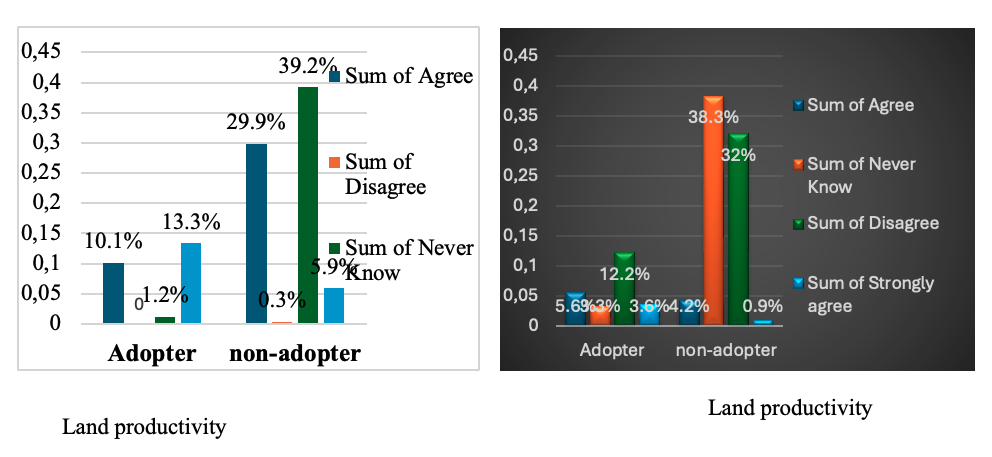
The survey data presented in the accompanying graph highlights a notable positive perception regarding the impact of tractor usage on land productivity among respondents. Specifically, 40% expressed agreement with the benefits of tractors, while an impressive 19.2% indicated strong agreement. Together, this results in a substantial 59.2% of participants viewing tractor usage favorably in enhancing agricultural productivity. This overwhelming consensus suggests that many farmers recognize the potential of tractors to improve efficiency and output in their operations.
However, it is concerning that 40.4% of respondents indicated uncertainty about whether this technology truly improves land productivity. This significant proportion reflects a gap in awareness and understanding among farmers regarding the benefits and functionalities of tractors. It underscores the need for targeted education and capacity-building initiatives to inform farmers about how tractors can be effectively integrated into their practices. Furthermore, the negligible 0.3% of respondents who disagreed about the benefits of tractor. Increasing awareness and providing hands-on training could help bridge this knowledge gap, ultimately leading to greater adoption of tractor technology and enhanced agricultural productivity.
4.2.2. Distribution comparison of HH perception towards positive effect tractor machinery on land productivity
The results illustrated in Figure 4 indicate a mixed perception among respondents regarding the impact of tractor machinery on labor productivity. Only 9.9% expressed agreement, and 4.5% indicated strong agreement, culminating in a total of 14.4% who believe that tractors enhance labor productivity. In contrast, a notable 44.2% of respondents disagreed with this assertion, highlighting a significant skepticism surrounding the benefits of tractor use. Additionally, 41.6% of participants reported uncertainty, indicating a lack of knowledge about the effects of tractors on labor productivity.
When comparing the responses of adopters versus non-adopters of tractor technology, a clear distinction emerges. Adopters exhibit higher levels of agreement and lower levels of disagreement or uncertainty regarding the productivity benefits of tractors. This suggests that those who have integrated tractor machinery into their operations possess greater knowledge and firsthand experience, leading them to recognize its positive impact on both land and labor productivity. Tamirat and his co-authors reveals that shortage of labor is one factors determine tractor adoption. In general, the data clearly indicates that the integration of tractors into agricultural practices fosters significant advancements in land productivity, ultimately benefiting farmers and contributing to food security.
The findings underscore the need for educational initiatives targeted at non-adopters to enhance their understanding of tractor benefits. By addressing the knowledge gap, it may be possible to increase adoption rates and improve overall productivity in agricultural practices.
4.3. Interview and discussion result about perception towards tractor adoption
Interviews were conducted with heads and experts from zonal and district agricultural offices, the liben credit and agriculture-based farmers’ cooperative union, and a tractor hiring firm. The results of these interviews indicate a growing demand for tractor mechanization in the region. Participants emphasized that tractor mechanization significantly enhances productivity when compared to traditional oxen ploughing. Moreover, the use of tractors reduces both the time and labor required for ploughing, making it an effective solution for mitigating seasonal variability, especially during years with unpredictable rainfall. In such circumstances, tractors are preferred due to their efficiency in completing ploughing tasks quickly.
Farmers consistently reiterated the significant improvements in labor efficiency that tractors offer. Many described how mechanization has alleviated the physical demands of traditional farming methods. One farmer noted, "with tractors, I can finish ploughing my field in a day, something that would take me a week with oxen." this sentiment aligns with the survey data indicating that a majority of respondents recognize the positive impact of tractors on labor productivity.
However, there are challenges associated with tractor technology. Issues related to fuel availability and spare parts pose significant bottlenecks for widespread adoption. Additionally, the cost of repairs can be prohibitive in some cases. Despite these challenges, there is a noticeable increase in both demand and awareness regarding the benefits of tractor mechanization among farmers. Overall, the insights gathered from these interviews suggest a positive trend towards embracing mechanization in agriculture, highlighting its potential to improve productivity and adapt to changing climatic conditions while acknowledging the existing hurdles that need to be addressed.
4.4. Focus group discussion result
Discussions were held in four villages within the district, featuring purposefully selected community representatives. The villages where focus group discussions (fgds) took place are gurura baka, tombe anchabi, leman ayetu, and dembeli keta. A total of 16, 20, 15, and 22 participants joined from each village, respectively. Each group included individuals from various positions within the community. Most discussions focused on the adoption of tractor mechanization, they perceptions towards the comparative advantages of tractors over oxen, their preferred methods for accessing tractors whether through hiring, or purchasing at least through cooperation, and finally challenges related to tractor technology.
The discussion results revealed a unanimous enthusiasm among participants, with nearly all groups expressing a strong interest in adopting tractor technology to enhance their agricultural practices and productivity. In the discussions regarding the adoption of tractor mechanization, participants expressed a strong preference for utilizing tractors over traditional oxen. The consensus highlighted several key points that underline their enthusiasm for this technological advancement.
Adoption of tractor mechanization: participants unanimously agreed that adopting tractor technology would significantly enhance their agricultural practices. They articulated a desire to transition from oxen to tractors, emphasizing the efficiency and speed that tractors offer. The mechanization of farming tasks was seen as a crucial step towards modernizing their agricultural operations, ultimately leading to increased productivity.
Perceptions of comparative advantages: the participants shared their perceptions regarding the comparative advantages of tractors over oxen. They noted that tractors not only improve labor productivity by performing tasks faster but also enhance land productivity. The ability of tractors to work on larger plots of land in a shorter time frame was highlighted as a major benefit. Additionally, they recognized that tractors can contribute positively to soil fertility by enabling more precise and efficient farming techniques, such as better tillage and crop rotation practices.
Preferred methods for accessing tractors: when discussing how to access tractor technology, participants expressed a preference for cooperative purchasing models. While they were open to hiring tractors as needed, they believed that coordinating efforts to purchase a tractor collectively would be more advantageous. This approach would not only reduce individual costs but also foster a sense of community among farmers, allowing them to share resources and knowledge effectively.
Challenges related to tractor technology: despite their enthusiasm, participants acknowledged several challenges associated with adopting tractor technology. The high initial purchase price of tractors was a significant concern, as many farmers may struggle to afford them individually. Additionally, the availability and cost of spare parts were highlighted as potential hurdles that could hinder the maintenance and longevity of tractors. Fuel-related issues, including rising prices and inconsistent supply, were also identified as obstacles that could complicate the use of tractor technology in their farming operations.
In summary, the discussions revealed a collective eagerness among participants to embrace tractor mechanization, driven by the perceived benefits in productivity and efficiency. While they recognized the challenges associated with this transition, their preference for cooperative purchasing and shared resources indicates a proactive approach to overcoming these barriers. The potential for improved agricultural practices through tractor use is seen as a vital step towards achieving sustainable farming in their communities.
5. CONCLUSION
In conclusion, the research reveals that tractor adopters demonstrate significantly higher productivity per household compared to non-adopters, despite utilizing fewer laborers and less farmland. This efficiency indicates that the adoption of tractor technology enhances production capabilities, suggesting a potential pathway for improving agricultural practices among non-adopting households.
The study highlights the critical role of tractor adoption in enhancing agricultural productivity, focusing on labor and land efficiency among households. The analysis identified labor availability and land size as essential factors influencing the decision to adopt tractor technology. However, it goes beyond these basic considerations by examining how tractor adoption positively impacts both labor and land productivity within the study area. By employing MANOVA (Multivariate Analysis of Variance), the research effectively isolates the effects of tractor usage on land and labor productivity, and efficiency respectively. The results clearly reject the null hypothesis, indicating significant differences in productivity metrics between tractor users and non-users. Specifically, the data reveals that adopters achieve an impressive average labor productivity of 11.33 kg/man day, compared to a mere 3.20 kg/man day for non-adopters. Similarly, tractor improves land productivity among tractor adopters reaches 16.60 quintals per hectare, substantially higher than the 9.22 quintals per hectare observed in non-adopting households. This increase in land productivity can be attributed to the efficient cultivation of larger areas evenly ploughed by tractor technology, resulting in greater overall yields.
The analysis also indicates that adopting a tractor increases labor productivity by 8.11 kg/man day and land productivity by 7.38 quintals per hectare over the traditional farming system. The qualitative survey data reveals a predominantly positive perception of tractor usage among respondents, with 59.2% acknowledging its benefits for land productivity. While 40% agree and 19.2% strongly agree on the advantages, a concerning 40.4% remain uncertain about tractors' effectiveness in enhancing productivity. This uncertainty highlights a significant knowledge gap among farmers regarding tractor functionalities, emphasizing the necessity for targeted educational initiatives to improve understanding and integration of this technology.
In contrast, perceptions regarding labor productivity are notably mixed. Only 14.4% of respondents believe tractors enhance labor productivity, with a substantial 44.2% expressing disagreement and 41.6% uncertain about their impact. This skepticism suggests that many farmers lack sufficient information on how tractor adoption could improve labor efficiency. A comparison between adopters and non-adopters reveals that those who have integrated tractors into their farming operations are more informed and confident about the technology's benefits. This disparity indicates that firsthand experience plays a crucial role in shaping perceptions of local community on the adoption of tractor machinery.
Interviews with agricultural experts and farmers showed a growing interest in using tractors for farming. Participants highlighted that tractors improve productivity compared to traditional oxen ploughing, saving time and labor. Many farmers shared how tractors make their work easier, with one stating that he can plough a field in a day instead of a week with oxen. However, challenges like fuel availability and repair costs hinder wider adoption of tractor technology.
Focus group discussions in four villages revealed strong enthusiasm for tractor mechanization among community members. Participants agreed that switching to tractors would improve their farming practices and increase productivity. They preferred tractors over oxen for their speed and efficiency, seeing mechanization as essential for modernizing agriculture. Overall, there is a clear trend towards adopting tractor technology, which could significantly benefit farmers despite the existing challenges that need to be addressed.
Overall, the findings underscore the importance of educational initiatives aimed at non-adopters to bridge the knowledge gap and promote the benefits of tractor technology. By enhancing awareness and providing hands-on training, it may be possible to increase adoption rates, thereby improving agricultural productivity and contributing to food security. Addressing these gaps is essential for maximizing the potential of tractors in modern farming practices.
To enhance tractor adoption in agriculture, policymakers should prioritize infrastructure development, ensuring accessible fuel supply and repair services. Local government leaders, agricultural sector, and communities facilitate and attend training programs on tractor operation and maintenance, empowering farmers with essential skills. Formal and informal institutions like cooperatives should play a vital role by pooling resources for collective tractor ownership, reducing individual costs. NGOs should focus on raising awareness about the benefits of mechanization while advocating for financial support or subsidies to alleviate initial investment barriers. Collaborative efforts among these stakeholders will foster a supportive environment for tractor technology, ultimately improving productivity and sustainability in farming practices across the region.