For three decades after the Cold War, most European forces prepared for crisis management, counter-terrorism and limited deployments rather than prolonged interstate war. Governments cut stocks, accepted long replacement cycles and relied on lean production. Defence firms remained dependent on public demand and regulation, yet were pressed to meet commercial efficiency standards. EU defence expenditure reached EUR 418 billion in 2025, yet collaborative procurement accounted for only 24% of equipment procurement, below the long-standing 35% benchmark [1]. The result was an advanced but thin industrial base with little idle capacity, redundancy or strategic stock. Russia’s full-scale invasion of Ukraine exposed these weaknesses.
Europe entered the current rearmament cycle with advanced firms but thin inventories, long production lead times, and nationally divided procurement [2]. The policy debate first centred on whether governments would spend more [3]. It now concerns what that spending buys, where it is produced, and how long forces can be sustained [4]. Existing evidence shows rapid budget growth alongside persistent shortfalls in common purchasing, ammunition, air defence, repair, and critical inputs [1]. These facts support a shift from expenditure totals to the conversion of money into usable and replaceable capability [5].
The article's central claim is that readiness is a production and coordination problem before it is a budgetary aggregate. Money creates capability only when demand is credible, contracts last long enough to justify investment, standards permit scale, and firms can obtain finance, labour, components, testing, and permits. The same logic extends beyond factories. Rail, ports, energy, digital networks, maintenance sites, and public finance must continue to function under sustained disruption.
Three research strands inform this debate but rarely meet in one account. Defence economics studies market power, procurement, and the effects of military spending [6]. European integration research studies national sovereignty, comgmon instruments, and the gradual growth of EU authority [7]. Industry assessments document output constraints and supply risks [8]. What is missing is a clear account of the links that join budget decisions to production, sustainment, civilian resilience, and deterrence. This article addresses that gap through one conversion model and a set of measurable tests.
The research question is: Under what economic and institutional conditions can the EU convert rising defence expenditure into a durable capacity to replace losses, sustain military support, protect essential infrastructure, and preserve macroeconomic stability during prolonged conflict? The article makes three findings. First, credible common demand is the main condition for private investment in capacity. Second, resilience depends on lower-tier suppliers, labour, repair, and civilian infrastructure as much as on prime contractors. Third, the EU's main role is to reduce the cost of coordination across national systems, not to replace national force planning or NATO operational authority.
These findings are propositions drawn from the reviewed evidence. Describing common demand as the main condition identifies the emphasis of the proposed model; the article does not estimate its causal importance relative to finance, inputs, labour or other constraints.
National reforms show both the scale of the effort and the risk of divergent paths. France's Military Programming Law allocates EUR 413.3 billion for 2024-2030 [9]. Germany changed its Basic Law so that defence and specified security spending above 1% of GDP is excluded from the debt brake [10]. Poland planned PLN 200.1 billion for defence in 2026, equal to 4.81% of GDP [11]. These decisions widen demand, but they do not by themselves create common specifications, European supply, or shared repair and logistics.
A prolonged conflict is treated here as an economic condition in which military demand remains high across several budget cycles, losses and repairs are continuous, infrastructure faces physical and cyber disruption, and governments must support both operations and ordinary social life [12]. This definition places industrial policy inside the wider debate on economic security [13]. It also makes preparedness a deterrence question: an adversary must expect Europe to restore capability, finance operations, and maintain political order after the first shock [14].
Methodologically, the article uses a structured qualitative analysis of policy instruments and secondary quantitative evidence, combining peer-reviewed research on defence economics and European integration with official data from the EDA, EU institutions, NATO and the IMF, as well as specialised assessments produced by the IISS, SIPRI and the Kiel Institute. The method is appropriate because prolonged-conflict preparedness cannot be reduced to a single dependent variable: it must be evaluated through the relationship among expenditure, procurement, production, supply security, innovation, labour, logistics and fiscal sustainability. The empirical period extends to July 2026, allowing the analysis to incorporate the latest EDA expenditure data and the implementation architecture created by SAFE, EDIP and the Defence Readiness Roadmap 2030.
Source inclusion is purposive, based on direct relevance to the conversion of expenditure into sustained capability. The principal empirical period is 2020–July 2026, with earlier studies retained for historical and theoretical context. Legal acts and implementation reports establish responsibilities, instruments and intended outcomes; official statistics describe reported expenditure and capacity; academic studies inform explanations of procurement incentives and economic effects. Table 1 groups recurring requirements into production, supply continuity, adaptation, sustainment and economic support, while Figure 2 links these functions analytically. EDA provides the reference evidence for EU expenditure; NATO evidence retains its own membership and definitions. Conflicting or incomplete observations are assessed against their dates, coverage, price bases and indicator definitions, and are left qualified where these cannot be reconciled. Missing implementation evidence is treated as an evidence gap.
1. DEFENCE INDUSTRIAL CAPACITY AS AN ECONOMIC-SECURITY PROBLEM
1.1. Production, surge and mobilisation capacity
Defence industrial capacity is the set of assets and relationships that allows an economy to design, produce, integrate, repair, and replace military capability. It includes factories, tooling, software, intellectual property, test ranges, trained labour, supplier networks, storage, transport, and through-life support [15]. Final assembly is therefore a poor measure on its own. A missile line may have space and machinery but still lack guidance units, motors, energetic materials, cleared engineers, or certified testing [16]. A small shortage can stop a production chain whose final output is worth far more than the missing input.
Defence production also differs from ordinary manufacturing. Governments are the main buyers, entry is restricted, development costs are high, and product cycles are long. In many segments, one public buyer negotiates with a small number of suppliers. Firms invest when they expect orders to cover fixed costs and when the public buyer shares some technical and demand risk. Governments, however, retain the right to change requirements and must answer to annual budget controls [6]. Readiness therefore depends on contracts that combine predictability with review points, performance tests, and competition where entry is possible.
For analytical purposes, three forms of capacity should be distinguished. First, normal capacity is the output that can be produced under peacetime contracts without exceptional measures. Second, surge capacity is the ability to raise output for a limited period through additional shifts, inventories, subcontracting or reserved production slots. Third, mobilisation capacity is the ability to transform the wider economy over a longer period by creating new facilities, reallocating labour, converting civilian production and coordinating strategic inputs. European policy has concentrated primarily on expanding normal and surge capacity, particularly for ammunition, missiles and air defence [14], while full mobilisation remains politically and legally difficult because it would require stronger public direction over private production, energy allocation, transport and labour. A credible preparedness strategy must nevertheless consider all three levels, since a conflict that lasts several years progressively transforms a surge problem into a mobilisation problem [17].
Table 1. Analytical components of defence industrial readiness
| Dimension | Economic function | Diagnostic indicators | Typical failure in prolonged conflict |
|---|---|---|---|
| Productive capacity | Replaces losses and expands output after demand rises. | Output rates; lead times; reserved production slots; tooling; testing and repair capacity. | Budget growth becomes queues, price escalation, or imports rather than added European output. |
| Supply security | Maintains production when trade, transport, or suppliers are disrupted. | Supplier concentration; critical-input stocks; substitution options; energy and cyber resilience. | A low-value specialised input stops a high-value production chain. |
| Technological adaptation | Allows systems and doctrine to respond to changing threats. | Prototype-to-contract time; software update cycles; user feedback; open architectures. | Long acquisition cycles deliver technically advanced but operationally dated systems. |
| Logistics and sustainment | Keeps equipment usable and moves it to the operational area. | Maintenance capacity; spares; storage; transport corridors; certification and interoperability. | Equipment exists but cannot be repaired, supplied, or deployed at the required rate. |
| Macroeconomic endurance | Sustains military effort without destabilising the wider economy. | Fiscal space; import intensity; labour; inflation; energy costs; political legitimacy. | The defence effort becomes fiscally or socially unsustainable before strategic aims are met. |
Source: authors’synthesis based on on Hartley and Belin (2020), Young (2023), International Institute for Strategic Studies (2024), European Commission and High Representative (2025), NATO (2025), Hackett et al. (2025).
Table 1a. Public evidence and proposed tests of industrial readiness
| Indicator | Public observations | Interpretation and remaining evidence |
|---|---|---|
| European collaborative equipment procurement | EDA reported 11% in 2020 and 18% in 2021 [19]. | Published snapshots; changes in reporting participation limit comparison. |
| Collaborative investment in defence programmes | The 2022 CARD assessment reported 18% conducted in cooperation [20]. | Programme-based investment, rather than an annual equipment-procurement ratio. |
| Collaborative procurement in 2025 | 24% including EU and/or third-country collaboration; a separate European measure was 11%, with 19 states reporting [1]. | Different partner coverage and incomplete reporting prevent a continuous, directly comparable series. |
| Contract duration, lead time, stock cover and repair turnaround | Proposed indicators; these are not measured in this article. | Comparable contract, production and operational records are needed to apply the proposed tests. |
Source: EDA expenditure and cooperation data from 2022 and 2026 reports.
1.2. The macroeconomics of rearmament
EU defence expenditure rose from EUR 279 billion in 2023 to EUR 343 billion in 2024 and EUR 418 billion in 2025. It is projected at EUR 454 billion in 2026 [21], [22], [1]. The corresponding burden rose from 1.9% of EU GDP in 2024 to 2.2% in 2025 and an expected 2.4% in 2026. Equipment procurement reached EUR 115 billion in 2025, while defence research and development reached EUR 17 billion [1]. These increases create a larger market, but they also intensify competition for engineers, explosives, electronics, test facilities, and energy.
The economic effect of rearmament is conditional [23]. Spending can raise output when domestic capacity is available, procurement is implemented quickly, and firms invest in plant and skills [24]. It can instead raise imports, prices, or debt when supply is tight [25]. IMF estimates for the EU find positive short-run output effects and cross-border spillovers, especially for equipment procurement, but stress import intensity and fiscal space [23]. Earlier research also reports wide variation across countries and model choices [24], [26], [27]. Security policy should therefore judge spending by delivered capacity and long-run fiscal cost, not by one multiplier.
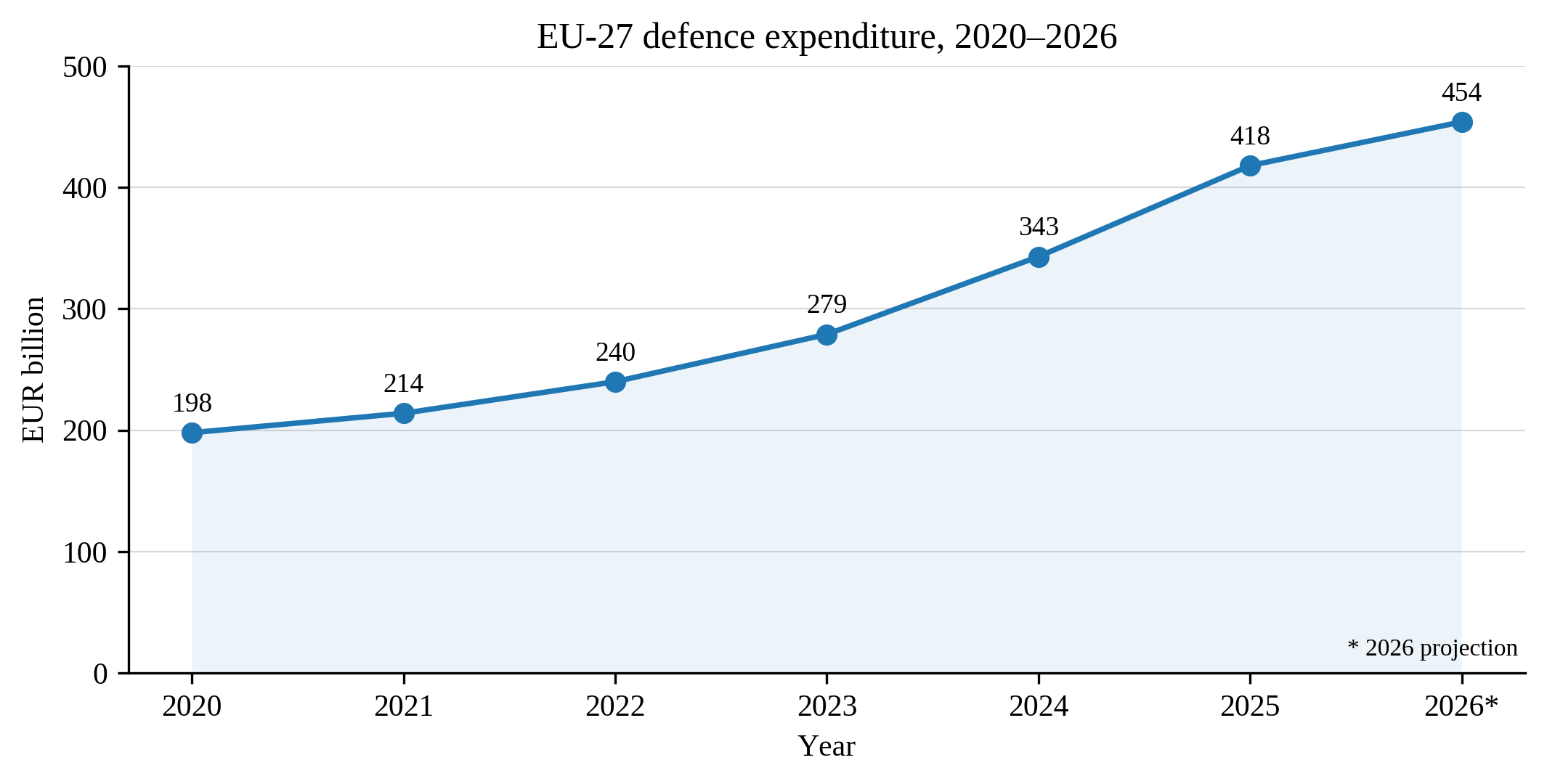
Source: Authors' representation based on European Defence Agency and Council of the European Union data. Information for 2026 is based on a projection of European Defence Agency (2026).
Note on prices and coverage: The 2020–2025 headline totals use each reporting year’s prices. The 2026 projection is in constant 2025 prices. The first two observations cover 26 EDA states, excluding Denmark; totals include all 27 from 2022 [21], [19], [28]. The calculation is (454/198 − 1) × 100 = 129.3%. It compares the displayed amounts across changing coverage and price bases, so it does not measure harmonised real growth. The latest EDA edition uses constant 2025 prices throughout and rebases the 2024 total to EUR 349 billion; EUR 343 billion is the earlier 2024-price headline [1], [22]. Values through 2025 are reported totals, while 2026 remains a projection.
Figure 1 shows a 129% rise in EU defence expenditure between 2020 and the 2026 projection. The composition is as important as the total. Investment exceeded 32% of expenditure in 2025, but common procurement represented only 24% of equipment spending. Twenty-three Member States reached at least 2% of GDP, yet national programmes still shape most orders. The result is a larger demand signal without full market consolidation [29]. The EDA series and the Council's defence indicators support the same direction of travel and show why production, collaboration, and delivery must be tracked beside budgets.
The steep expenditure trajectory shown in Figure 1 alters the macroeconomic environment in which industrial policy operates, because the scale and simultaneity of national demand can intensify competition for engineering labour, explosives, electronic components and testing facilities even while it creates stronger incentives for investment. The IMF’s cross-country estimates suggest that equipment procurement has particularly strong output effects and that spillovers cross national borders, yet the size of the multiplier depends on import intensity, fiscal space and implementation efficiency; consequently, the same nominal increase may generate domestic capacity in one Member State, external procurement in another and inflationary pressure in a third [23]. A European assessment must therefore distinguish between the budgetary input, the location of production and the capability eventually delivered.
2. FRAGMENTED DEMAND AND THE INDUSTRIAL ECONOMICS OF SCALE
2.1. National procurement and the cost of fragmentation
Fragmentation persists in requirements, certification, contract timing, export policy, and industrial protection. EU forces operate more than 150 weapon systems, compared with a few dozen in the United States under commonly used classifications [5], [30]. Only 18% of defence investment was collaborative in 2022 [20]. The 2025 share of collaborative equipment procurement was 24%, still below the 35% EDA benchmark, established in 2007. Different threat perceptions and national employment goals explain part of the gap, but market size, work-share bargaining, and fear of foreign dependence also shape procurement choices.
The weapon-system comparison refers to the Munich Security Report 2017, which reported 178 systems in Europe and 30 in the United States using 2016 data and a wider European grouping; it is a historical illustration, not a current EU-27 inventory [30]. The 18% figure concerns investment in defence programmes assessed in the 2022 CARD cycle [20]. The 24% figure uses equipment procurement as its denominator and includes EU and/or third-country cooperation; the 35% benchmark concerns European collaboration. These percentages therefore have different reporting bases and partner coverage, and do not establish a six-percentage-point improvement in one unchanged indicator [1].
EU policy now tries to change the incentives before contracts are signed. The European Defence Industrial Strategy set targets of 40% common procurement by 2030, at least half of procurement expenditure on European products, and 35% intra-EU trade in defence goods [31]. EDIP adds support for common projects, production, supply security, and cooperation with Ukraine [32]. The Defence Readiness Roadmap advances the joint-procurement target to 40% by the end of 2027 [33]. These targets matter only if Member States align requirements and schedules before national tenders harden.
Common procurement can increase bargaining power, spread development costs, and support interoperability. It can also produce delay when states seek different specifications, industrial work shares, export rights, or command over upgrades [34]. Research on Eurofighter, A400M, naval projects, and cooperative procurement shows that the gains from scale are real but not automatic [35]. Effective programmes need one stable requirement, clear authority over change, and rules that prevent every participant from treating domestic industrial return as the main measure of success [36].
2.2. Credible demand and the decision to invest
Industrial capacity cannot be expanded instantaneously because defence production involves long lead times for specialised machinery, environmental permits, secure facilities, testing equipment and qualified personnel, while lower-tier suppliers may require investment before prime contractors can increase final assembly. This creates a temporal mismatch between the political demand for rapid delivery and the industrial reality that additional output often appears only after several years. Firms may respond to urgent orders by drawing down inventories or extending shifts, but these measures cannot sustain output indefinitely if explosive materials, electronic components or skilled workers remain constrained. Governments that expect industry to maintain reserve capacity without paying for it effectively ask private firms to carry a public insurance function, even though shareholders normally evaluate unused facilities as an avoidable cost [6].
Recent national measures are beginning to support capacity. France's multiannual plan gives firms a longer demand horizon [9]. Germany's fiscal reform reduces the risk that annual debt rules interrupt large programmes [10]. Poland combines very high defence spending with the EU's largest potential SAFE allocation, creating scope for production and licensed assembly [11], [37]. These states are at the forefront of demand, while Sweden, Italy, Spain, Czechia, and the Baltic states are also expanding selected missile, land, aerospace, ammunition, and drone capacity [29]. The policy question is whether these investments form connected European supply and repair networks or remain parallel national projects.
The Act in Support of Ammunition Production, adopted in 2023, was the EU's first direct industrial response to a specific wartime production shortage. It provided EUR 500 million for 31 projects in explosives, powders, shells, missiles, testing, and certification [38], [39]. The grants were expected to attract about EUR 1.4 billion in total investment and support capacity of two million artillery shells a year [39]. Commission reporting points to a substantial increase in capacity, but the lasting result depends on follow-on orders after the grant period [39].
The Commission’s announcement of 15 March 2024 reported annual capacity for 155 mm shells of one million in January 2024 and projected two million by the end of 2025; these are capacity figures, not verified deliveries [39]. A separate delivery example makes the distinction concrete: on 31 January 2024, the High Representative reported 330,000 artillery rounds already delivered to Ukraine and anticipated 524,000 by March against the one-million commitment. The latter figure was a forecast, and deliveries included transfers from existing stocks. This example illustrates delayed fulfilment without estimating an aggregate causal relationship between expenditure and output [40].
A public announcement is not the same as a bankable order. Firms need contract duration, volume, advance payments, and credible options for renewal before they finance plants and supplier expansion [32]. The EU can provide incentives and common rules, Member States must sign and manage contracts, and NATO can align the demand with force requirements and standards [34]. Negotiation should therefore settle requirement, quantity, delivery authority, and risk allocation before financing is committed.
3. INDUSTRIAL BOTTLENECKS IN A PROLONGED CONFLICT
3.1. Ammunition, air defence and consumption rates
A prolonged high-intensity conflict is defined partly by the relationship between consumption and replacement, because a force that possesses advanced equipment but cannot replenish ammunition, interceptors and spare parts will experience declining effectiveness even if its platforms remain intact.
Operational endurance depends on the ratio between consumption, repair, and replacement. Artillery ammunition offers the clearest example, yet the same logic applies to air and missile defence, where relatively expensive interceptors may be used against cheaper drones or cruise missiles, creating an adverse cost exchange and pressure on inventories [8]. European governments have therefore moved from stock replacement toward targets for sustained output, common stocks, and protected production. The White Paper, NATO production plan, and Readiness Roadmap all call for longer orders and higher availability, but they do not publish a single common consumption model [8], [14], [33]. Scenario ranges should guide contracts without exposing operational plans.
Air and missile defence shows the tension between urgent purchase and industrial development. Member States are buying available systems while the Roadmap creates a European Air Shield, a Drone Defence Initiative, and an Eastern Flank Watch [33]. Capability coalitions and project definitions were scheduled for early 2026, with financing and contracts expected before the end of 2028 [33]. EDF selections now include more than fifteen projects linked to the four readiness flagships [41]. The next step is to convert project lists into interoperable sensors, effectors, command systems, stocks, and maintenance capacity.
Ammunition capacity must be measured across the whole chain. Shell bodies, explosives, propellants, primers, fuses, packaging, testing, storage, and transport must expand in compatible ratios [42]. Permitting and safety zones limit the speed of new plants, while qualified chemists and operators remain scarce [38]. ASAP reduced some bottlenecks and showed that EU grants can draw private investment into basic inputs [39]. It also showed the limit of emergency funding: without multiannual orders, new capacity may be underused after the immediate shortage eases.
3.2. Critical inputs, energy and supply-chain concentration
Military systems depend on critical minerals, semiconductors, optical parts, machine tools, chemicals, batteries, cloud services, and commercial software. Many inputs are produced several tiers below the prime contractor and serve much larger civilian markets. Defence ministries often have weak visibility at those levels. A product assembled in Europe may still rely on one foreign processor, precursor chemical, magnet, or electronic component. Supply security therefore requires mapping by function and restoration time, not only by the nationality of the final supplier.
China-US rivalry changes the EU's access to advanced chips, rare-earth processing, machine tools, and trusted digital systems [18]. US export controls can restrict the transfer or re-export of technology, while Chinese controls can constrain materials and components [18], [43]. The EU must therefore manage both security partnerships and exposure to decisions taken outside its institutions.
The practical goal is managed dependence rather than autarky. Authorities should identify components whose loss would stop high-value production, diversify suppliers, hold stocks for the period needed to qualify alternatives, and support recycling or substitution where it is economical [18]. Trusted-partner agreements can preserve access to technology that Europe cannot reproduce at acceptable cost [44]. Procurement rules should also require lower-tier disclosure and recovery plans, subject to protection of classified and commercial information.
Table 2. Principal bottlenecks and policy responses in the European defence industrial base
| Bottleneck | Mechanism of vulnerability | Appropriate policy response | Evaluation criterion |
|---|---|---|---|
| Short and fragmented orders | Firms cannot recover fixed investment costs; national variants divide production runs. | Multiannual common contracts, advance commitments, and standard requirements. | Higher contracted output and shorter unit lead time, not only announced expenditure. |
| Concentrated critical inputs | Single suppliers or external jurisdictions can interrupt whole production chains. | Supplier mapping, strategic stocks, recycling, substitution, and trusted-partner sourcing. | Time required to restore production after loss of a critical supplier. |
| Skills and security clearances | Expansion is limited by workers who need long training and vetting. | Skills partnerships, apprenticeships, mobility of cleared staff, and stable recruitment. | Vacancy duration, training completion, and retention in critical occupations. |
| Slow innovation adoption | Commercial and battlefield technologies fail to enter programmes before needs change. | Operational testing, modular standards, milestone contracts, and protected routes for SMEs. | Time from validated prototype to operational contract and field use. |
| Maintenance and logistics gaps | Platforms are purchased without enough spares, repair, storage, or transport access. | Through-life contracts, distributed repair hubs, strategic stocks, and dual-use infrastructure. | Availability rates and repair turnaround under surge conditions. |
Source: Authors' analysis based on European Defence Agency (2025, 2026), Furceri et al. (2026), Hackett et al. (2025), International Institute for Strategic Studies (2024), NATO (2025), Burilkov et al. (2025).
4. INNOVATION, LABOUR AND THE CIVILIAN FOUNDATIONS OF MILITARY ENDURANCE
4.1. Technological adaptation and the lessons of Ukraine
The war in Ukraine has demonstrated that industrial capacity is not synonymous with the mass production of fixed designs, because battlefield conditions can change faster than traditional acquisition cycles and render systems vulnerable to electronic warfare, countermeasures or software adaptation.
Ukraine’s defence ecosystem has developed short feedback loops in which users report operational problems, firms modify designs and updated systems return to the field within weeks or months, particularly in drones, communications and electronic warfare [16]. Traditional European acquisition separates development, certification, and use over long periods. That protects safety and accountability but can deliver a system after the threat has changed [42]. A two-speed model is needed: strict assurance for safety-critical platforms and shorter test-contract-update cycles for software-intensive or rapidly replaceable equipment.
European and NATO initiatives now cover different stages of innovation [45]. The EDF finances collaborative research and development [46]. EUDIS supports start-ups and small firms, HEDI links experiments to military users, and AGILE is designed to fund faster testing and market entry from 2027 [41], [45], [47]. NATO's DIANA connects innovators to sixteen accelerators, more than 200 test centres, and operational users [48]; the NATO Innovation Fund supplies long-term equity from a fund backed by twenty-four allies [49]. These instruments reinforce one another only when successful trials lead to procurement and integration.
HEDI 2.0 addresses the point at which many projects fail: the move from a promising prototype to a military capability. It places more weight on operational experimentation, end-user evidence, cooperative design, and fit-for-purpose procurement. It can help Member States test the same solution against comparable requirements and reduce repeated national trials. Its contribution to EU readiness should be judged by the number of systems that pass from experiment to contract, the time required, and the share adopted by more than one armed force [45].
4.2. Workforce, mobility and infrastructure
Labour is a binding capacity constraint. The wider European defence industry recorded EUR 183.4 billion in turnover and about 633,000 direct jobs in 2024, an 8.6% annual employment increase [50]. More than 2,500 small and medium-sized firms participate in its supply chains. Growth raises demand for engineers, welders, chemists, software specialists, technicians, and security-cleared managers [29]. Training must start before new plant is completed, and cross-border mobility should recognise clearances and qualifications without weakening security controls.
These totals follow ASD’s coverage of 20 member countries: 17 EU states, Norway, Türkiye and the United Kingdom. Turnover is in nominal euros. This geography differs from the EU-27 expenditure series, so the two series cannot establish a direct expenditure-to-output conversion ratio [50].
Industrial output has little military value if equipment cannot move, be stored, or be repaired. Roads, railways, bridges, ports, airports, fuel networks, and digital traffic systems are mainly civilian assets [8]. Load limits, border procedures, incompatible rail standards, and limited repair sites can delay deployment [12]. The EU's military-mobility work links corridor investment with regulatory simplification and dual-use funding, but demand exceeds available finance [51]. Readiness tests should therefore measure travel time, cross-border permissions, fuel access, spare-part flow, and repair turnaround under degraded conditions.
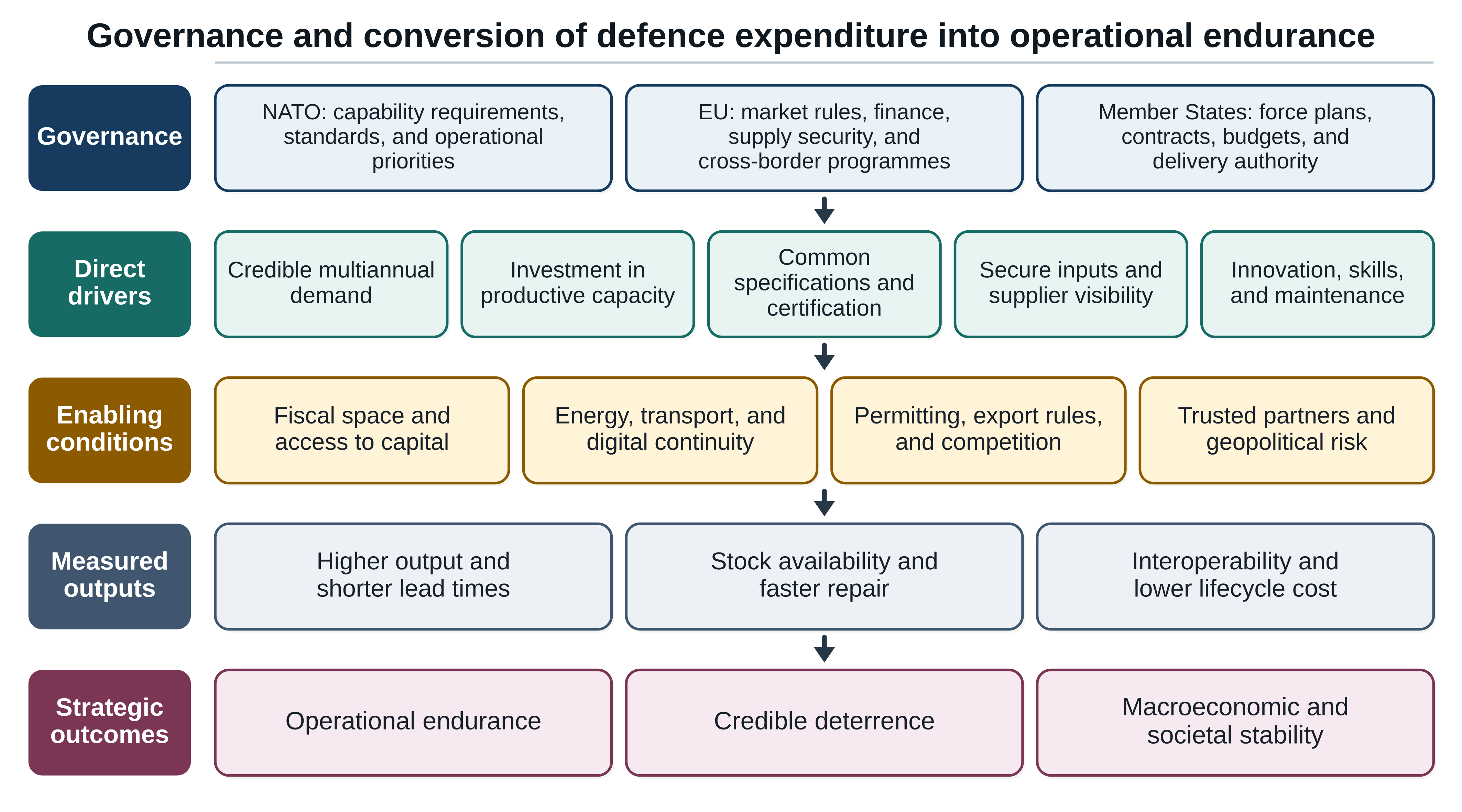
Source: Authors' model based on defence-economics and EU-NATO readiness evidence. The following resources were used to create this framework: Hartley and Belin (2020), European Commission and High Representative documents for 2025 and NATO (2025).
Note: Figure 2 is an untested conceptual model. The arrows depict the authors’ proposed mechanisms, while ‘Measured outputs’ identifies indicators proposed for subsequent assessment. The dashed return arrow connects operational experience and supply disruption to revised contracts, specifications and investment decisions.
Figure 2 presents industrial readiness as a governed conversion process. NATO supplies operational priorities and standards; the EU supplies market, finance, and cross-border instruments; Member States retain budgets, force plans, and contract authority [16]. Direct drivers include demand, investment, specifications, inputs, skills, innovation, and maintenance [33]. Enabling conditions include fiscal space, infrastructure, regulation, and geopolitical access. Expected outputs are higher production, shorter lead times, stock availability, faster repair, and interoperability [14]. The final outcomes are endurance, deterrence, and macroeconomic stability [23]. Feedback from operations and supply disruption must change contracts and standards, not remain outside the system.
Spending is therefore presented as an input rather than a readiness result: credible deterrence and operational endurance arise from the quality of the conversion process, while macroeconomic and societal stability depend on delivering capability in a way that controls lifecycle costs and reduces supply and geopolitical exposure.
5. FINANCING AND GOVERNING EUROPEAN DEFENCE INDUSTRIAL EXPANSION
5.1. Capital, risk and the financing gap
Europe's industrial base is led by a small group of prime contractors. Airbus and MBDA anchor aerospace and missiles; Thales and Leonardo are central in sensors, electronics, and command systems; Rheinmetall and KNDS lead major land and ammunition programmes; Saab supplies aircraft, sensors, missiles, and undersea systems [5]. SIPRI counted twenty-six European firms outside Russia among the world's top one hundred arms producers, with combined 2024 arms revenue of about USD 151 billion [52]. These firms integrate large programmes, but their output depends on thousands of smaller suppliers. Finance must therefore reach both the prime and the constrained tier below it.
The SIPRI total covers the Top 100 sample of companies headquartered in Europe outside Russia, including non-EU countries, with overseas subsidiaries consolidated under their parent companies; it is not an EU-27 industry total [52].
The EIB has broadened eligibility for security and defence and increased support for supply-chain firms. Its role is useful because guarantees and intermediated lending can reduce the risk faced by commercial banks [53]. Yet finance cannot replace a contract. A supplier is creditworthy when a credible customer commits to sufficient volume and pays on workable milestones. Effective support must join research grants, procurement, plant finance, and working capital across the firm's development cycle [54].
SAFE uses EU borrowing to offer up to EUR 150 billion in loans for common procurement and industrial investment. It lowers financing costs and links support to priority capabilities, European supply, and cooperation with Ukraine and eligible partners [55]. By mid-2026, the Council had approved assistance for eighteen Member States, with large allocations for Poland, Romania, Italy, France, and others [37]. SAFE reduces the cost of national borrowing, but it does not remove debt, implementation, or specification risk.
The approved maximum loans were EUR 43.73 billion for Poland, EUR 16.68 billion for Romania, EUR 15.09 billion for France and EUR 14.90 billion for Italy. Romania was the second-largest approved beneficiary. These ceilings identify authorised assistance rather than disbursements or completed procurement [56], [57].
Small and dual-use firms face a different financing problem. They may own relevant software, materials, sensors, or manufacturing methods but lack clearances, procurement records, and cash for long payment cycles [47]. Grants can support testing, while guarantees and equity can fund growth [49]. The missing link is often a route to a first production contract. Public support should preserve competition, protect access for new suppliers, and avoid turning temporary aid into permanent protection for firms that do not meet cost, delivery, or performance tests.
5.2. EU instruments and the governance of a European public good
The public-good claim concerns the shared security benefits of industrial preparedness and the insurance value of reserve capacity. Weapons and production slots remain scarce and excludable. Capacity financed by one state can nevertheless benefit others through faster replenishment and collective deterrence, encouraging reliance on investment undertaken elsewhere. Joint financing is justified where these cross-border benefits are demonstrable and should specify cost-sharing, access rights, delivery obligations and compensation for maintaining available capacity [6], [13].
The EU's present role grew from measures adopted after the Lisbon Treaty [46]. PESCO created binding project commitments among participating states in 2017 [58]. CARD added a recurring review of national plans and opportunities for cooperation [59]. The European Defence Fund moved EU money into collaborative research and development [46], while the European Peace Facility created an off-budget means to finance external security action [60]. The pandemic then strengthened the case for joint purchasing, strategic stocks, and emergency coordination across national markets.
After 2020, the EU moved from research support toward procurement, production, and supply security [31]. EDIRPA encouraged common purchases, ASAP funded ammunition bottlenecks, SAFE added large loan capacity, and EDIP created permanent industrial measures and projects of common interest [61], [38], [55], [32]. This sequence shows institutional growth, but Member States still control force planning, most procurement, and exports [55]. Article 346 (which allows Member States to protect their national security interest) of the Treaty on the Functioning of the European Union and national security exceptions remain important, so common action depends on political consent as well as EU finance and law [62].
The continuing regulatory arrangements must be distinguished from the financing programme. Regulation (EU) 2025/2643 provides a EUR 1.5 billion envelope for 2025–2027; this does not secure funding beyond 2027. References to permanent measures concern the legal arrangements for cooperation and security of supply. Longer-term demand credibility still requires subsequent budget decisions and contracts [32].
Table 3. EU instruments for defence industrial capacity and preparedness
| Instrument | Primary mechanism | Expected industrial effect | Main limitation |
|---|---|---|---|
| European Defence Fund (2021–2027) | Co-finances collaborative defence research and development. | Reduces duplication and forms cross-border technological consortia. | Development funding does not guarantee later common procurement or production scale. |
| ASAP (2023–2025) | Grants for ammunition and missile production bottlenecks. | Expands capacity in explosives, powders, shells, testing and certification. | Temporary support requires follow-on orders to prevent newly created capacity from becoming stranded. |
| EDIRPA (2023–2025) | Financial incentives for joint procurement by Member States. | Aggregates demand and encourages interoperable acquisitions. | Small budget relative to national procurement and continued sovereignty over requirements. |
| SAFE (2025) | Up to EUR 150 billion in EU-backed loans for eligible common procurement. | Improves financing conditions and supports larger, coordinated orders. | Loan uptake and industrial additionality depend on national plans and procurement execution. |
| EDIP (2025) Funding period: 2025–2027. | Permanent programme, common project structures and supply-crisis framework. “Permanent” concerns regulatory arrangements; the financing envelope is EUR 1.5 billion for 2025–2027. | Creates stronger governance for availability, common programmes and integration with Ukraine. | Effectiveness depends on implementation, budget scale and Member State willingness to use common structures. Funding beyond 2027 is not secured by this envelope. |
Source: Authors' analysis based on the EDF, ASAP, EDIRPA, SAFE, and EDIP legal acts. The legal acts used for this table come from: European Parliament and Council of the European Union (2021, 2023, 2025) and Council of the European Union (2025).
5.3. EU–NATO coordination and the transatlantic relationship
The European Union and NATO perform different but complementary functions in defence industrial readiness. NATO defines collective defence requirements, capability targets, standards and operational planning, while the EU possesses regulatory, financial, industrial and infrastructure instruments that can help Member States deliver those capabilities. Duplication becomes costly when the two organisations develop competing standards or planning assumptions, but complementarity is possible when NATO identifies operational demand and the EU supports aggregation, production, mobility and supply-chain resilience. The Updated Defence Production Action Plan explicitly emphasises demand aggregation, open framework contracts, standardisation and visibility over capacity, while EU policy increasingly aligns industrial projects with NATO capability priorities [14].
EU-NATO cooperation is broad because twenty-three countries belong to both organisations and the two institutions report seventy-four common actions [63]. NATO sets capability targets, operational standards, and defence plans [64]. The EU can finance production, shape market rules, fund mobility, and support supply security [63]. The 2025 Hague commitment also linked 3.5% of GDP for core defence with up to 1.5% for resilience, infrastructure, and related security investment, giving both organisations a shared interest in measurable industrial and civilian output [64].
The main split concerns the balance between transatlantic access and European industrial preference. NATO favours interoperable supply across the Alliance and rapid access to proven systems [14]. EU instruments increasingly reserve benefits for European production, trusted partners, and limits on non-European content [31]. These aims can coexist if urgent foreign purchases are paired with licensed production, technology access, European maintenance, and later common orders [64]. Future coordination should use one set of capability priorities, compatible standards, and regular reporting on contracts, output, and delivery [63].
6. ECONOMIC PREPAREDNESS FOR PROLONGED CONFLICT
6.1. Extending preparedness beyond the defence sector
Industrial readiness cannot be isolated from the wider economy because defence production competes for capital, labour, energy, transport and technological inputs, while households and firms must continue functioning under elevated uncertainty.
The Commission adopted the Preparedness Union Strategy in March 2025 as an all-hazards, whole-of-society, and whole-of-government policy. It calls for common risk assessment, a crisis dashboard, stronger emergency coordination, minimum preparedness requirements, exercises, stockpiling, and closer civilian-military planning [13]. Implementation has moved beyond a statement of intent: the EU Stockpiling Strategy and the Medical Countermeasures Strategy were adopted in July 2025, and work now covers stock gaps, logistics, and cooperation among national reserves [65]. The remaining test is whether these initiatives set measurable service and recovery standards.
A prolonged conflict would expose the dependence of military output on civilian electricity, data, finance, insurance, transport, health services, and specialised logistics [12]. Commercial efficiency often removes spare capacity that becomes valuable in a crisis [13]. Authorities should identify essential functions, set minimum continuity levels, pre-authorise emergency contracts, and exercise failures across sectors [65]. Plans should also specify who can allocate scarce transport, energy, and components, how firms are compensated, and how normal market confidence is restored after temporary intervention.
6.2. Policy priorities to 2030
The first priority is aggregated, multiannual demand linked to agreed capability gaps. Governments should align requirements before tendering and use common standards where scale and interoperability matter [31]. Orders must be large and long enough to justify investment, but they should include delivery milestones, price review, and competition for later batches [66]. Ammunition, air and missile defence, drones, secure communications, and logistics are suitable areas for common demand [36].
The second priority is to finance productive capacity, not only final purchases [23]. Grants, loans, guarantees, and advance payments should support tooling, testing, energetic materials, maintenance, supplier digitalisation, and workforce training [32]. Contracts should pay for reserved surge capacity and strategic stocks when these serve a public insurance function [54]. Support should be conditional on added output, shorter lead times, supply security, and access for smaller firms [55].
The third priority is lower-tier supply visibility [39]. The EDA, Commission, and national authorities should map single-source dependencies and the time required to qualify substitutes [18]. Critical-material stocks should be tied to restoration periods rather than broad lists [18]. Defence requirements must also enter semiconductor, energy, transport, and raw-material policy [44]. Information systems should protect classified and commercial data while still allowing public authorities to detect a production stop before it reaches final assembly.
The fourth priority is a differentiated innovation system. Large platforms still require strict testing and long-term support [45]. Software, sensors, autonomy, and rapidly replaceable systems need shorter contracting and update cycles [47]. Ukraine should remain a source of operational evidence and industrial cooperation [41], [32]. HEDI, EDF, EUDIS, AGILE, DIANA, and private capital should use shared test results where security rules permit, with adoption and serial production as the main measures of success [41], [45], [47], [48], [49], [46].
The fifth priority is civilian preparedness. Military mobility corridors, ports, energy networks, telecommunications, healthcare, payment systems, and repair capacity should be tested against prolonged disruption [14]. Dual-use projects should be selected by operational need and recovery value, not by accounting convenience [51]. The NATO resilience category and EU preparedness instruments offer more finance, but each project should state the military function served, the civilian benefit, the expected recovery time, and the authority responsible for maintenance [64], [65].
The five priorities should be tested together through common scenarios. One exercise could assume simultaneous high ammunition demand, loss of a critical supplier, cyber disruption at a port, and pressure on public borrowing. The causal path would run from contract decisions to supplier response, transport, repair, and force availability [13]. Core indicators should include contract duration, output per month, lead time, collaborative share, supplier concentration, stock cover, vacancy duration, border-crossing time, repair turnaround, and fiscal cost [14]. The Annual Defence Readiness Report should publish comparable results and identify who must correct each failure.
The analysis is limited by reliance on official and self-reported statistics with uneven coverage and limited access to classified stocks and firm-level production. Announced budgets, approved loans and production targets do not establish completed contracts, realised output or operational availability, especially for instruments adopted in 2025–2026. The July 2026 cut-off excludes later developments, and no interviews or firm-level investment study are provided. Figure 2 and the proposed tests therefore organise hypotheses for assessment; they do not identify causal effects, rank constraints empirically or measure whether available stocks would sustain a particular conflict.
CONCLUSIONS
The contribution finds that the EU has entered a sustained rearmament cycle without yet completing the industrial and institutional changes needed for endurance. Spending, investment, and employment are rising. Common procurement, supply visibility, repair depth, skills, and contract certainty remain weaker. The policy problem is therefore not a lack of recognition. It is the rate at which national budgets are converted into shared and replaceable capability.
Expenditure and capacity must remain separate measures. Higher budgets are necessary after years of underinvestment, but money can produce imports, queues, price growth, or duplicated systems when supply is inelastic and requirements remain national. Capacity grows through bankable orders, common specifications, investment finance, protected inputs, trained labour, maintenance, and rapid adaptation. Progress should be reported through output, lead time, availability, and repair, not only appropriations.
Preparedness also extends beyond the defence sector. Military movement depends on civilian transport, production depends on energy and data, and fiscal endurance depends on a productive economy and public consent. The EU is well placed to work in these areas because it controls important market, financial, infrastructure, and regulatory instruments. Its task is to make national effort more compatible and less vulnerable while leaving operational command to NATO and force decisions to Member States.
Industrial endurance supports deterrence because it changes an adversary's estimate of time. A first strike or early battlefield advantage is less valuable if Europe can replace losses, protect infrastructure, finance operations, and maintain political cohesion. Redundancy and stockpiles carry visible peacetime costs, but the absence of a few critical functions can impose far larger costs during conflict. The correct standard is therefore proportionate insurance against interruption, not complete self-sufficiency.
Readiness 2030 has moved into implementation. The Commission selected fifty-seven EDF projects worth EUR 1.07 billion, proposed five European Defence Projects of Common Interest with a long-term funding ambition near EUR 190 billion, and advanced SAFE financing for eighteen Member States [41], [67], [37]. Co-legislators have also provisionally agreed measures to reduce permitting and administrative delays [68]. These steps are material, but their value will depend on contracts, construction, production, delivery, and common use.
The next research and policy question is whether the new instruments can create binding accountability before the main 2027-2028 milestones. Annual reporting should trace each priority capability from requirement to contract, European value added, output, deployment, and sustainment. That record would show whether common finance changes national procurement behaviour or merely adds another funding layer. Europe's readiness will be credible when institutions can show not only what was announced, but what can be delivered, repaired, and replaced under stress.