INTRODUCTION AND LITERATURE REVIEW
Motivation has been deemed as an essential condition for (effective) learning to take place, since it can influence “what we learn, how we learn and when we choose to learn” [1]. Ellis and Johnson [2] mention some factors that could affect a learner’s motivation, alongside their response to training and learning potential: general personal data, educational background, knowledge of other languages and other language learning experience, attitudes and assumptions about language learning and learning style. While, in the case of job-experienced learners, motivation is mostly given by practical applicability of the acquired knowledge at work, pre-experience learners may be unsure about their future career and/or learning goals. Irina Iancu states that students “need to be aware of what actually motivates them to take foreign language classes, what learning strategies would better suit their type of intelligence and what their goals are within the course” [3].
We can generally distinguish between two different types of motivation: intrinsic (which comes from the inside, implying a person’s desire to do something without any external obligation or need) and extrinsic (which involves external forces, such as an obligation or requirement imposed from the outside). While intrinsic motivation might be considered more desirable in certain scenarios, extrinsic motivation (fuelled, for instance, by the need to perform better at work, getting a promotion or improving one’s qualifications with a view to increasing their income or status) can be very powerful in determining the learner to complete a course successfully. Therefore, the job-experienced learner will likely be more extrinsically motivated than the pre-experience one, but they would also have better-defined expectations from the course, based on their work. On the other hand, the pre-experience learner might be more intrinsically motivated (being interested in the language and culture for its own sake or for the purpose of self-improvement, no matter their future career), but will not likely have a clear vision of their practical learning needs. It goes without saying that the two types of motivation are usually intertwined in scenarios involving both types of learners. Moreover, most courses involve assessment, which is a classic example of extrinsic motivation, regardless of a person’s desire for personal self-improvement. However, especially in the case of large numbers of learners, it can be very difficult for the educator to cater to every individual’s learning needs and also maintain a high level of motivation throughout the course.
Michelle Miller points out that motivation is closely tied to emotions [4], which can have both benefits and downsides. In fact, Hutchinson and Waters argue, “the emotional reaction to the learning experience is the essential foundation for the initiation of the cognitive process” [5]. Emotions can be very strong, but they are also subject to change, depending on various factors, which means that a higher level of motivation can similarly be achieved if one identifies and is able to control those factors. However, according to the social cognitive approach to motivation, “our behavioral choices - what we are motivated to do, or not do - stem from a complex interplay between what we feel and what we believe” [4]. Therefore, motivation is a combination of emotions and cognition, which means that emotions may be rooted in beliefs. Nevertheless, it is possible to challenge these beliefs through persuasion, which in turn will modify emotions and potentially lead to positive outcomes in terms of motivation.
There are, of course, many other factors affecting motivation levels, including personality and, consequently, the language instructor can only do so much when it comes to increasing student motivation. Adding online education into the mix only complicates things [4, 6], as it is notoriously more difficult to engage your students and motivate them to learn in the absence of onsite, face-to-face activities. At the same time, the dynamics among these motivating factors is constantly changing, allowing for improvement throughout the course, since the level of motivation at the beginning of a course may vary significantly from the one measured during or at the end of the course. Moreover, according to Włosowicz, we must remember that even though motivation is essential for learning, it cannot replace the necessary effort to do so [7].
Bâcă and Popescu [8] conducted a needs analysis-focused study on 77 first-year students enrolled at the Faculty of Economic Sciences at Ovidius University of Constanța in the second semester of the 2022-2023 academic year, which included several questions regarding motivation. The results showcase that a lot of the respondents opted for a business education with a view to building a career in the field, preferably by working in a multinational company (closely followed by starting their own company). To this end, students involved in this study consider that speaking skills in English, followed by general and specialised vocabulary and text writing, would be of the greatest use to them in their future career. However, their immediate goal for studying English for academic purposes was to pass the exams and obtain a final graduation diploma [8].
Another study, conducted in a Chinese private university on students’ motivation to learn ESP, illustrates that all top four micro teaching practices which are most motivational involve the teacher, in the following order: teachers are considerate, development of a good relationship between teachers and students, the teacher constantly encourages students and the teacher gives positive feedback and evaluation to students [9]. Focus group interviews were also conducted as part of this study, with similar results: the teacher’s personality and the learning atmosphere play an important part in increasing student motivation, while among the least motivating practices are setting difficult tasks (which put pressure on students) and regular team projects [9].
Motivation is also connected to needs analysis. Dudley-Evans and St John warn that the mismatch between the institution’s perception of students’ needs and their actual needs often leads to a loss in motivation [10]. Therefore, it is very important for the teacher to collect information about this at the beginning of the course, as the findings may vary from generation to generation and from one area of specialisation to another.
To this end, the ESP teacher should conduct research and analyse data about what motivates students and what they expect from the course, keeping in mind that each cohort of students may display different characterisctics: for example, a group of 100 first-year undergraduates enrolled in the 2022-2023 academic year and specialising in Management may have (slightly) different reasons for selecting English as an object of study in detriment to French or German, the motivation behind their participation in the Business English class and their expectations from the teacher than the cohort specialising in Marketing or Finance and Banking, even though they are all business students at the same faculty, at the same time. Nevertheless, while each individual teacher or trainer can adapt the course to the specific needs of their students based on the results of their personal research, some general directions on how to motivate students can be identified and will be discussed later on.
A SURVEY ON STUDENTS’ MOTIVATION AND EXPECTATIONS
In line with what has been emphasized above about collecting data for ESP courses, and to serve as an example on how teachers can obtain some case-specific information about this topic, a small, informal survey was conducted at the Faculty of Economics and Business Administration in Iași, with a view to gaining some insight on first-year undergraduate business students’ motivation and expectations at the start of a Business English course, which would act as a starting point for future course design principles and choosing the right teaching approach for similar ESP courses.
An online questionnaire, consisting of 11 questions (including two questions concerning demographic information), was designed to elicit responses regarding students’ motivation for attending the course (which would serve as a starting point for the teacher), while also gauging their expectations regarding the learning and teaching processes (providing valuable ideas on how the level of motivation can be increased during the course, since a motivated learner will usually have some specific expectations from a course, as opposed to one that does not have a clear purpose in mind). Participation to the survey was voluntary, respondents were not compensated or incentivised in any way for completing the questionnaire and the answers (collected through Google Forms) were completely anonymous. The estimated time necessary for completing the questionnaire was between 2 to 4 minutes. All 41 respondents were enrolled as full-time students specialising in Management at the beginning of the 2024-2025 academic year. 82.9% of the respondents were female and 17.1% were male, with 40 respondents being between 18 to 21 years old and 1 respondent being over 25.
The first question referred to the foreign language (to be studied for four semesters) that students had opted for during the admission process. The three options provided by the Faculty of Economics and Business Administration are English (starting at intermediate level), French and German (both starting at beginner level). The results for this question indicate that there are two main reasons for students to continue studying English in tertiary education (considering that all of them have been studying English at school for at least 8 years): 58.8% of the respondents consider that English will help in their future career, followed closely by those who want to further improve their level of English through university courses (56.1%).
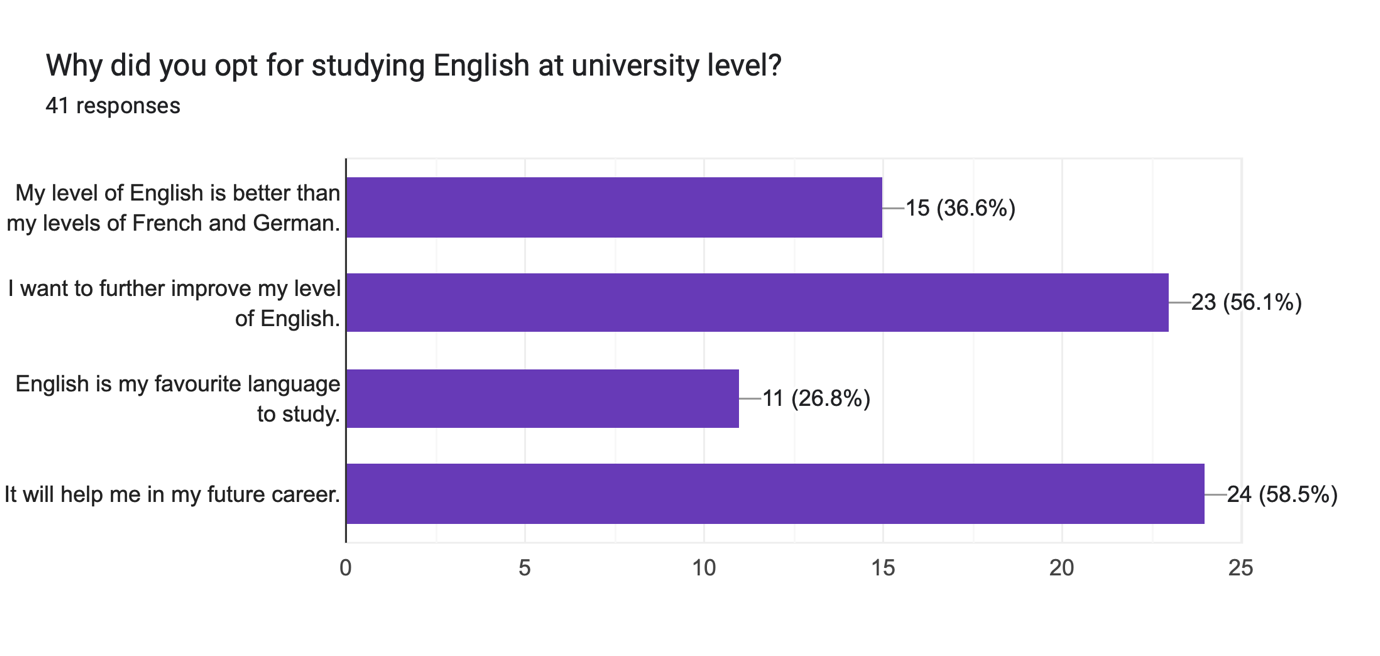
The following option, “My level of English is better than my levels of French and German,” was selected by 36.6% of the respondents. This could indicate that students feel confident enough in their current level of English and want to “play it safe,” rather than venture into the study of a foreign language that they are not familiar with and risk obtaining poor results or they are simply not willing to put in too much effort into this subject. Nevertheless, based on the top results for this question, we may conclude that students are quite motivated to continue studying English, being aware of its benefits for the future.
While the first question in the questionnaire referred to studying English in general, the second focuses on Business English, which is the subject that they study at the Faculty of Economics and Business Administration. This is likely the students’ first contact with ESP, but since they are to become business professionals, 70.7% of the respondents are very interested in attending the course. 29.3% are interested, while no respondents chose the “Not very interested” or “Not at all interested” options.
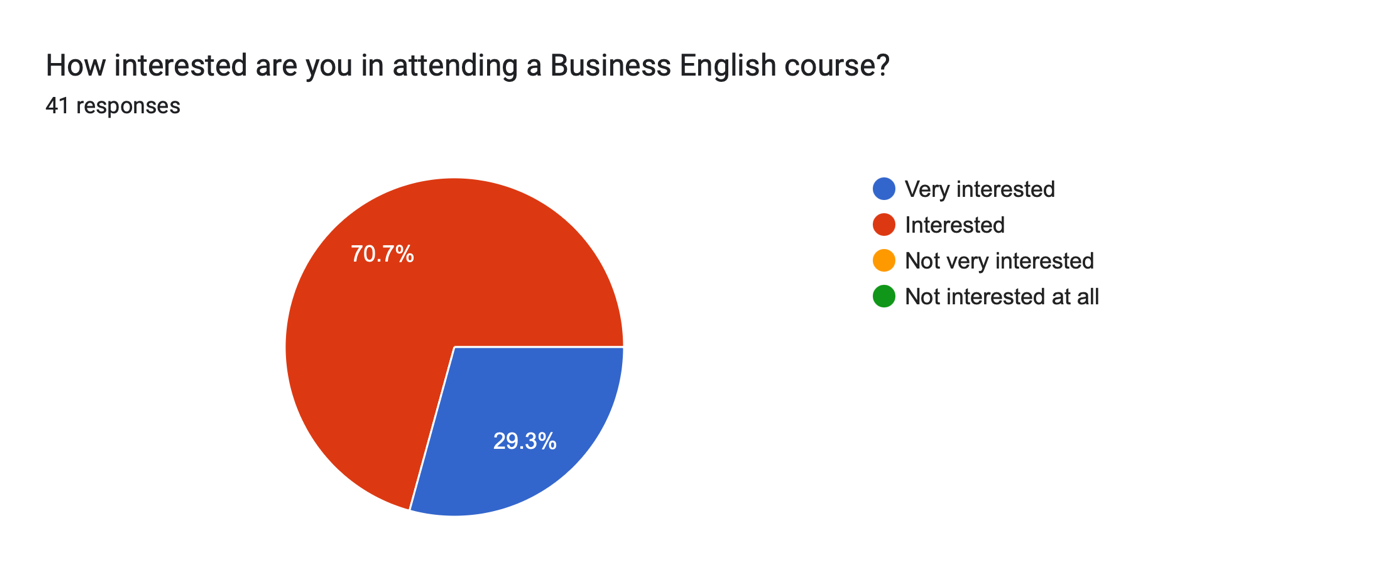
Based on the results so far, we can conclude that first-year undergraduates are definitely motivated to learn more about the field of Business English, which is a positive starting point for the teacher.
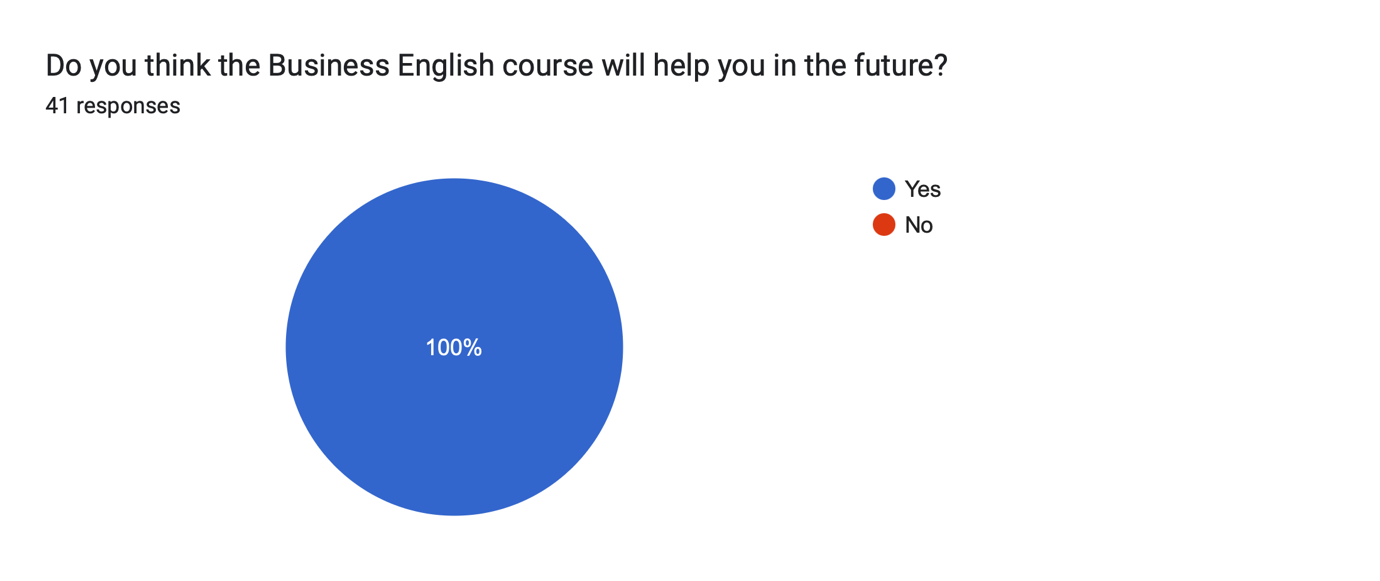
The answers to Question 3 (illustrated below) are even more encouraging, as the students’ interest in the BE course is clearly fuelled by their conviction that it will be useful to them in the future. All 41 respondents agreed on this, suggesting that a career in the field of business (whether it is working for another company or starting their own) is a strong (extrinsic) motivating factor.
The next question specifically enquires about the respondents’ motivation to study. The highest percentage of students (63.4%) seem to be intrinsically motivated, attributing their motivation to the desire to learn new things. Twenty respondents (representing 48.8% of the total number) are extrinsically motivated, by the prospects of a well-paid job. Fourteen answers (34.1%) indicated “Being the best at what I do” as the main motivating factor, while six answers (14.6%) were in favour of grades.
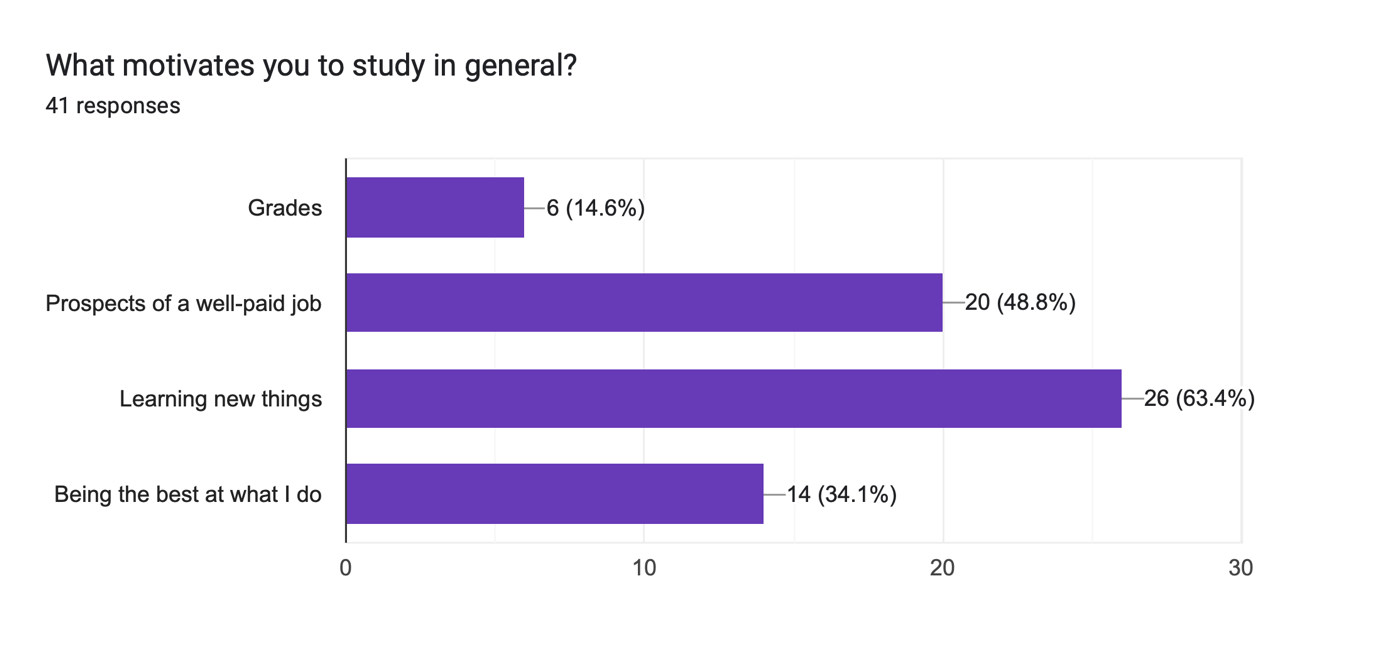
We notice that the answers are divided between extrinsic and intrinsic motivators, but the ratio is certainly in favour of intrinsic factors (in total, there are 40 answers indicating internal motivators – “learning new things” and “being the best at what I do” and 26 answers mentioning the other two options, which are external factors – essentially money and grades). If we look at individual answers, half of the respondents picked only one motivator from the four given options, while the rest chose more than one factor, with 11 answers including a combination of extrinsic and intrinsic motivators rather than making a clear-cut distinction between the two categories. The answers to this question support the idea that motivation is specific to each individual, according to their previous experiences, beliefs and feelings towards learning and studying in general.
Question number 5 focuses on how students think a Business English course could improve their professional development. The top two choices here were “feeling more confident in a business-related scenario” (63.4%) and “increasing my chances of obtaining a good job” (58.5%). The third given option, “I don’t think this course will help me in any way,” was only selected by 1 respondent (2,4% of the total answers).
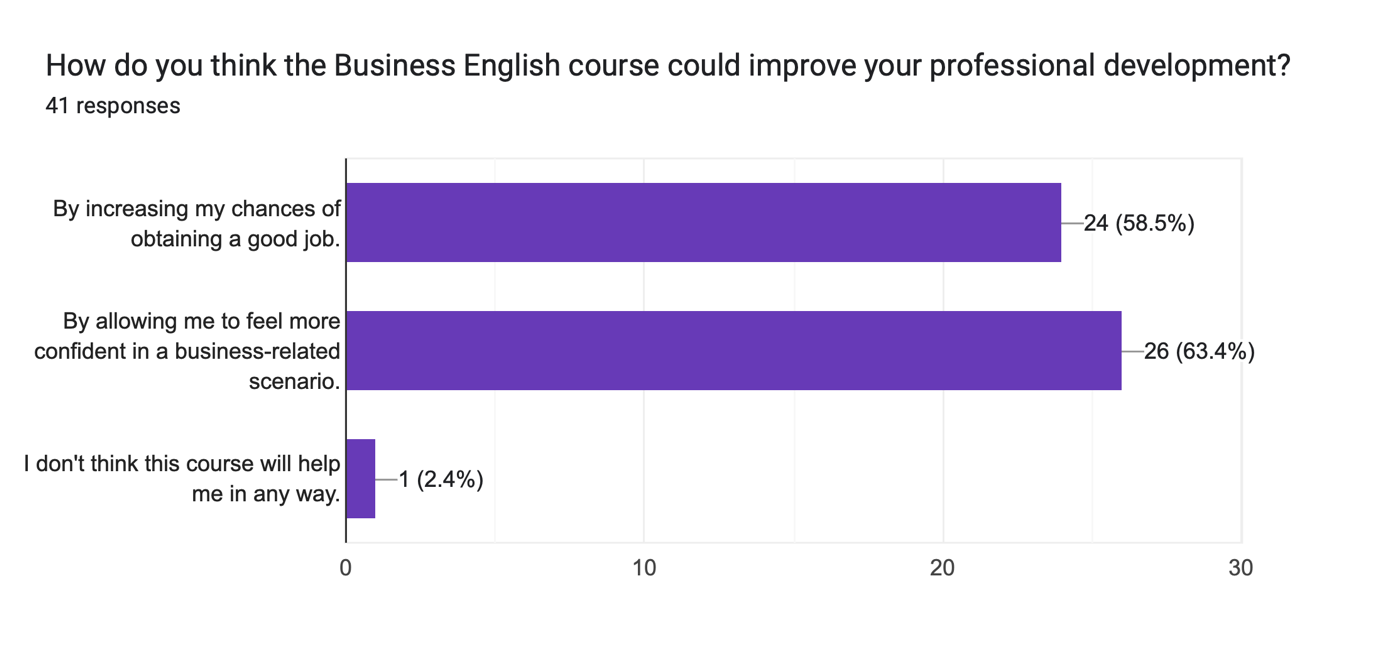
By correlating the answers collected for questions 1, 4 and 5, we can infer that there is a strong connection among students between the motivation to study (business) English and the prospects of obtaining their desired job. This suggests that they are driven towards developing a successful career, which combines intrinsic and extrinsic motivators such as: earning a high salary and getting a promotion (extrinsic), but also enjoying and feeling accomplished through the work itself (intrinsic).
The following two questions veer towards the students’ expectations about the course, in correlation with what motivates them and how they hope to achieve their goals.
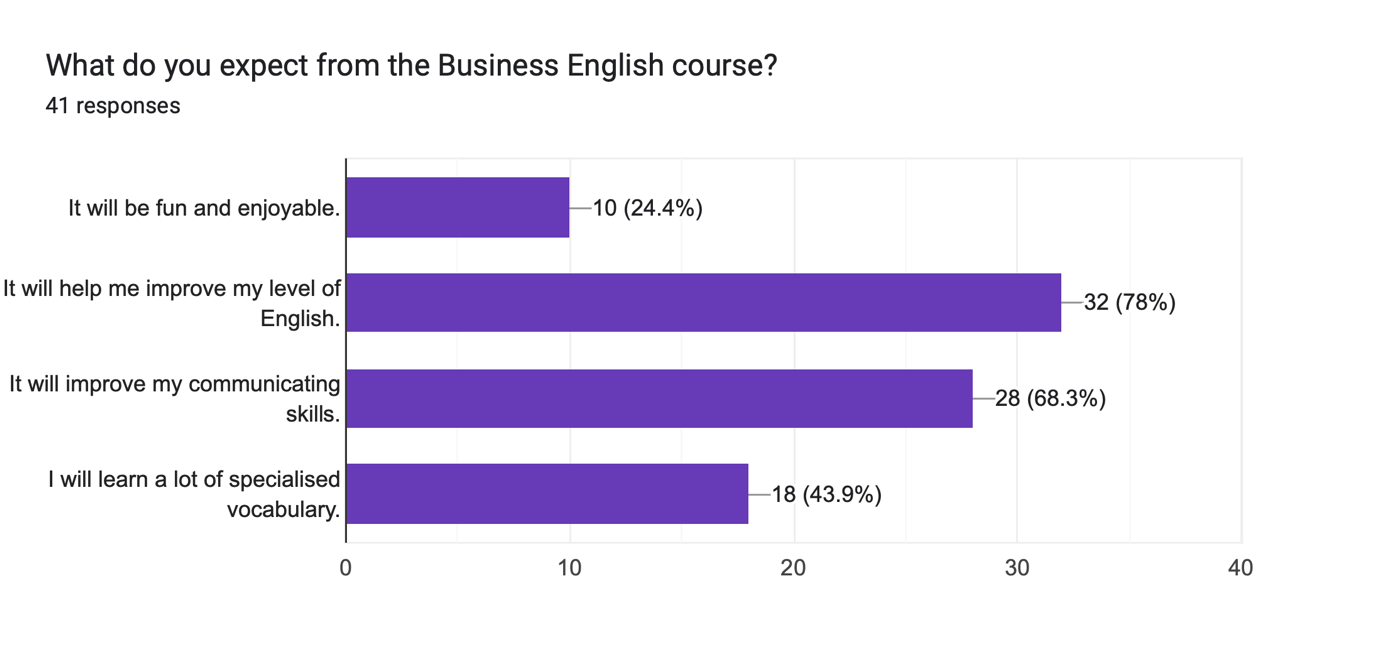
At Question 6, the largest number of respondents (78%) expect to improve their level of English through the Business English course, followed by 68.8% who think it will improve their communicating skills. Learning specialised vocabulary is also expected (43.9%), while 24.4% hope the course to be fun and enjoyable.
Improving communicating skills is clearly a priority for business students, and the following question details the skills which they consider to be the most important. The top answer (92.7%) is speaking skills, followed by listening (36.6%), writing (34.1%) and reading (24.4%). Developing their speaking skills is primarily what business students are looking for, as it was similarly concluded in the study conducted by Bâcă and Popescu, which was referenced in the introduction to this article. This shows that even pre-experience students are aware of their limitations in terms of their language skills, which leads to increased motivation in wanting to improve this situation by taking charge of their education.
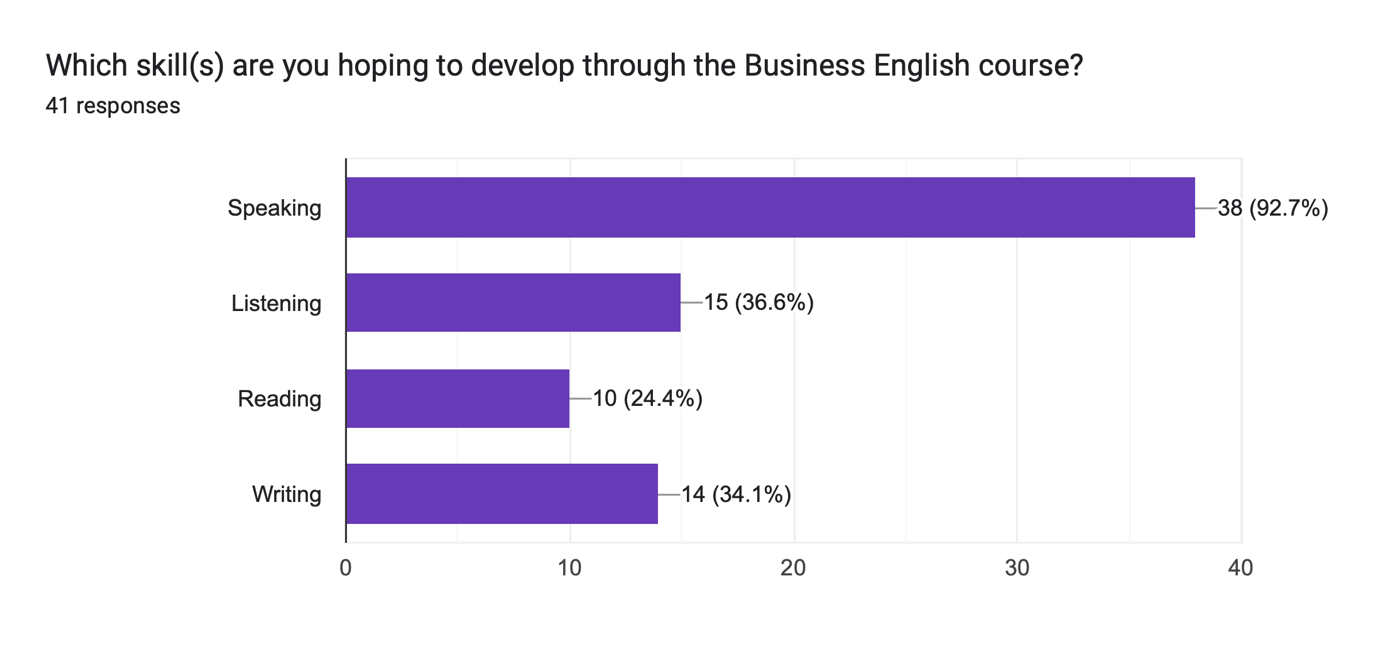
Therefore, Business English courses should definitely cater to these needs in order to maintain an optimal level of motivation among students. That is, teachers will have to design the course and plan activities in such a way that they take into account these expectations, while also considering the curriculum, time constraints, the number of students and their level of English.
The next question aimed at diving deeper into what students expect from a great course. Eleven options were provided here (including an open slot where respondents could add their own opinion), ranging from teaching methods to the lack of homework and learning materials. According to the limited data provided by this investigation, what makes a (language) course great is, first and foremost, the pleasant and relaxed atmosphere (58.8% of students consider this important). 56.1% put a lot of emphasis on the teacher being very good at their job, while 48.8% think that fun and accessible activities make a course great. This idea is in line with the results obtained in the Chinese study mentioned previously, which revealed that students are motivated when the task is not too difficult.
As we can see in the graph below, 36.6% of the respondents appreciate diversified teaching methods that are also adapted to students’ level, while 29.3% value a combination of individual and group work. Having no homework is something that students would enjoy (24.4% chose this option), but learning materials should also be relevant, up-to-date and interactive according to 22% of the respondents. 19.5% value fair and transparent evaluation and grading, 14.6% appreciate plenty of opportunities for interaction among students, constructive feedback (12.2%), while clear and accessible course objectives are important for 7.3% of the students questioned.
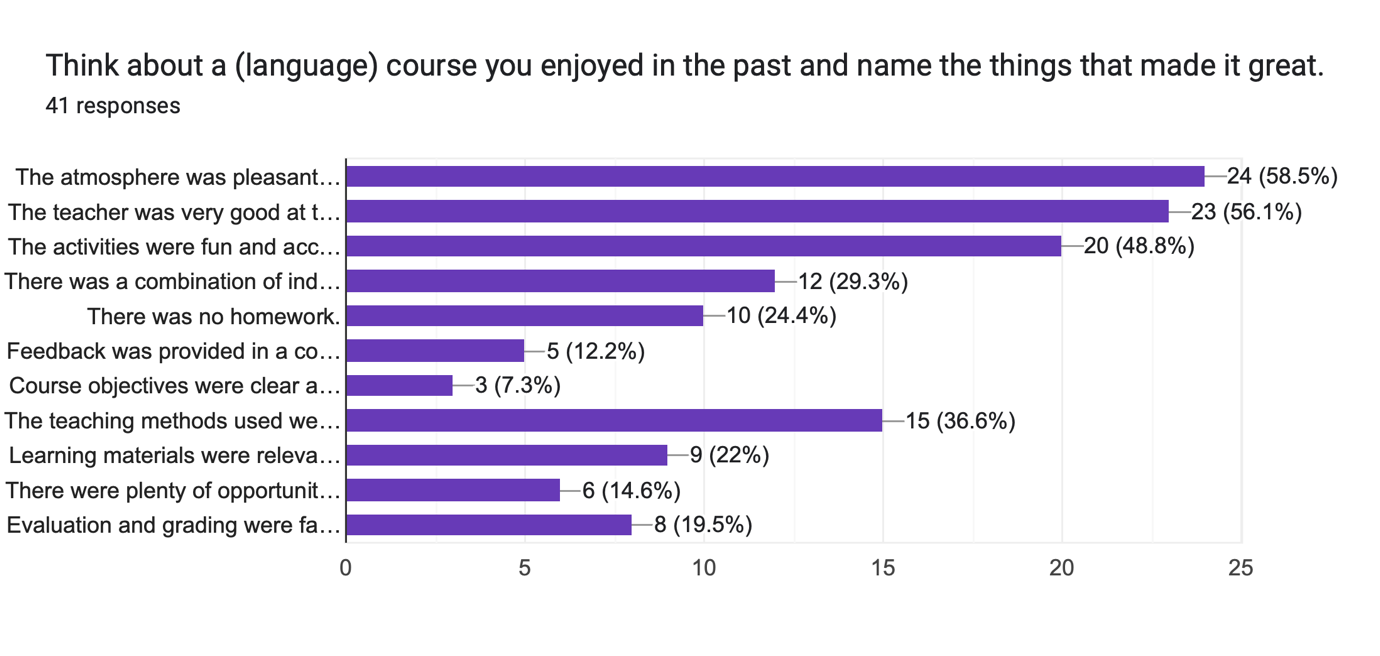
The top three answers to this question refer to the atmosphere, the teacher’s competence and the types of activities included, which is once again consistent with the top two motivating factors in the Chinese study, where the teacher’s personality and the learning atmosphere play an important part in increasing motivation.
Finally, the last question aimed to gauge the level of students’ motivation by inquiring how much time they were willing to spend on improving their English language skills outside the Business English course.

The “Two hours per week” option was selected by 56.1% of the respondents, followed by “Under an hour per week” (22%), “More than two hours per week” (19.5%) and “I don’t have time to work on my English outside this course” (2.4%). The fact that the great majority of respondents do allocate any amount of time to improve their skills outside the university course is an encouraging sign, and also proof that the students’ level of motivation (at least at the beginning of their first year) is high enough to prompt them to make an effort in order to improve their language skills. This is something that teachers should not overlook, as it showcases that having the right environment and content adapted to their learning needs is the best way to maximise students’ motivation and learning.
As previously mentioned, this is a very limited analysis, both in terms of the number of respondents and in the selected data collection method. Moreover, motivation to learn can sometimes be hard to define and is also subject to change, which means that the results may be very different if certain variables are modified (such as the time or day the information is collected, the context, the respondents’ perspective etc). A valuable addition to this empirical research would be the possibility to analyse the results in relation to a similar study conducted over several years and across several specialisations. Also, gauging motivation levels for the same students at the end of the course would offer more insight in comparison to those recorded at the beginning of the academic year. That said, the information collected does offer a glimpse into the learners’ perspective and can act as a starting point for potential adjustments to the course. It also highlights some key points that ESP practitioners should consider when selecting or designing materials and teaching methods with a view to maintaining or increasing the level of motivation for students entering tertiary business education. The third part of this paper provides a number of guidelines that have been formulated based on the author’s 10-year experience of teaching Business English at university level, the insights provided by this informal investigation of motivating factors and also the available literature in the field.
RECOMMENDATIONS FOR INCREASING STUDENT MOTIVATION
Based on the considerations above and the results of our survey, we have identified some directions towards increasing student motivation in the case of pre-experience ESP learners at university level. While they are not necessarily specific to the field of ESP and can be generally followed by any educator, they do take into account some of the specificities of teaching university business students and are examples of practical considerations that might act as a starting point to course design.
1. Creating a pleasant learning environment
It goes without saying that a positive classroom environment will foster students’ learning and generally discourage truancy, especially if the activities are enjoyable and accessible (to minimise learning anxiety). Given that, in many cases, the students’ level of English is not homogeneous, both their motivation and academic success rely on the teacher’s ability to achieve the right balance when it comes to stimulating learning without discouraging those who feel that their limited language knowledge will prevent them from completing a task. According to the results of our survey, a pleasant and relaxed atmosphere was the top priority for students when it comes to enjoying a course, which is consistent with the conclusions of the Chinese study and relates back to Hutchinson and Waters’ idea that the emotional reaction to the learning experience lies at the basis of the cognitive process [5]. Thus, while Business English is not among the core courses at the Faculty of Economics and Business Administration in Iași, it is still important to at least maintain a certain level of motivation towards learning among students, by making it as enjoyable as possible through the choice of materials and activity types, alongside fostering a positive learning environment (this particular point will be detailed later on).
2. Investing in teacher training
Considering what has been stated above, the success of a course and students’ motivation depend a lot on the teacher. A motivated student might lose interest in the course very quickly if they feel that it does not benefit their personal (career) goals and, vice versa, a demotivated student could suddenly discover that ESP is not only fun to learn, but it also improves their language skills in a way that really makes a difference to their professional life. Consequently, investing in teacher training is essential. In the case of Business English (and ESP in general), besides the methodological aspects of teaching a foreign language, instructors are rarely trained with specialised content in mind. As such, it is up to them to dedicate the necessary time and effort to design a course that reflects, at least in part, the perspectives of both the students and the academic institution in terms of content and teaching methodology. Starting from the process of needs analysis (which can include formal or informal studies, similar to this one, designed to identify specific aspects such as motivation levels at the start of a course), educators must constantly stay up to date with the developments in the field of ELT, whether by consulting relevant literature in the field or attending practical events dedicated to teaching methodology and specific aspects related to ESP. The latter will not, however, provide as relevant an information as the research targeted specifically at the students who are effectively enrolled in the course that the educator is about to teach.
3. Maintaining learning needs at the forefront of course design
ESP content is particularly reliant on learning needs, and even though most learners at university level are pre-experienced, tertiary education is about specialising in a certain field of activity, so it is important that they familiarize themselves with the specificities of English for business. As stated above, going through the process of needs analysis ensures that the course is relevant to the students and has a better chance of maintaining motivation levels high.
4. Focussing on improving speaking and listening skills
Following on from the previous recommendation, if a particular need is identified, then at least part of the course must target it directly. According to the survey results presented above, developing these two skills is particularly important to business students. For teachers, taking advantage of onsite student interaction (especially in the post-pandemic context) when designing or selecting classroom activities will ensure that this objective is met and students remain motivated.
5. Using learning materials that are up-to-date, authentic and relevant for the field of business
While it is difficult to produce new learning materials every year, it is important to make sure that the information provided to students is as current as possible, so that it maintains its relevance. 22% of respondents to our survey emphasized this aspect, which means that students will most likely be more motivated to learn if they feel that the content will help them navigate their current lives, rather than dwell on the past or describe inauthentic situations. Even if the coursebook is not the latest edition, the information provided by the teacher should at least reference the most recent data in the field.
6. Taking advantage of students’ willingness to study outside the classroom environment by assigning homework and research tasks to maximise language acquisition
As we have seen, students are generally willing to dedicate a certain amount of time (around two hours per week, according to our research) to studying outside the classroom, which means that this should not be a wasted opportunity for the teacher. Assigning homework (including project work) is a good way for teachers to ensure that students practise their language skills in a different context, other than the classroom. However, it must be mentioned that, according to the answers for Question 8 in our survey, having no homework was among the things that students appreciated about a course they enjoyed, so finding a balance between the two is important as well.
7. Building on students’ interest in the business world and emphasizing the importance of combining language competence with knowledge of cross-cultural communication
Considering the results to Questions 2, 3 and 9 in particular, it is clear that there is a strong interest on the students’ part to develop their language skills (particularly speaking and listening), given that they are aware of their importance in the business field they are hoping to activate in. This is a good opportunity for the teacher to introduce the concept of cross-cultural communication and what cultural differences entail for a businessperson. The interdisciplinarity of Business English ensures that students will be able to apply this knowledge to a variety of business-related scenarios, which will positively contribute to their level of motivation throughout the course and beyond.
8. Approaching assessment and success in a way that they foster a safe, positive and anxiety-free environment that encourages learning and personal development
This goes back to the first direction mentioned, creating a pleasant learning environment, as assessment anxiety plays a big role in the students’ perception of the course. Fair and transparent grading and evaluation, together with constructive feedback, are among the questioned students’ expectations when it comes to an enjoyable course and, as the two other cited studies suggest as well, they are definitely an important part of their learning experience. Thus, ensuring that they are not only extrinsically motivated (by grades) but also enjoy the learning process and find it useful is something that teachers need to consider when designing the course.
CONCLUSIONS
At the end of the day, motivation (to learn) is deeply personal. This statement may be approached in two different ways: it can either be an invitation for the teacher to propose an attractive course or it can just mean that each student will take what they need from any situation (when they need it), no matter how well it is thought out. Tertiary education is not mandatory, which means that university students have made the choice to continue their studies and have selected a certain area to specialise in. That, in itself, encompasses a certain level of motivation (to finish what was started, to become more employable, to learn more about the world etc.) that will greatly fluctuate with time, but it is nevertheless a good starting point for both them and the teacher. For the latter, it is also a reminder to constantly touch base with the beneficiaries of the education process and learn what their expectations are in terms of their future personal development.
The aim of this article was to identify some ways to increase student motivation in the case of an academic Business English course, starting from some relevant literature in the field and the results of a small, informal survey conducted among 41 undergraduate business students specialising in Management at a Romanian state university.
In the introduction to this paper, we started by discussing what the concept of motivation entails in terms of learning and what the two main types of motivation (extrinsic and intrinsic) are, according to various sources from the field of ESP teaching. Two studies (one conducted in a Romanian university and one in China) were also referenced, with a view to compare some of the results with our own investigation. While (learning) motivation is a topic that appears in ESP-related literature, it is not necessarily extensively analysed, which perhaps is due, in part at least, to the fact that it is rather subjective and tends to fluctuate a lot throughout, for instance, the length of a course. Therefore, it was emphasised that the ESP teacher plays a particularly important part in determining the students’ motivation level and needs in relation to the course.
The second part of the paper presented the results of our survey, providing some insight on a few students’ perspective on motivation right at the beginning of an ESP course, discussing them in relation to the two other studies mentioned in the introduction and drawing some conclusions on what this means for the language instructor.
Finally, based on the author’s own experience as a Business English teacher and what was inferred from our investigation, the third part of the paper contains eight recommendations for increasing student motivation in the case of ESP courses, which could be helpful to other practitioners who are looking to tailor their teaching to the specificities of this field. A combination of general teaching skills, creating a positive and anxiety-free learning environment, using relevant materials and personalisation to learner’s needs is certainly required in order for such academic courses to be as effective as possible in supporting students to develop their language skills and access positions that correspond to their aspirations and training.